
Rules for main forums
- Be nice
- No advertisement
- No events
- No fundraisers
- No topics asking for votes
- Only posts related to Brazilian Jiu Jitsu
Serious Question how do you define BJJ
6 year(s) ago • 1101 views • 38 replies
 PD
PDBlack belt 3rd degreeVerified

6 year(s) ago
Yesterday on the post about questioning the legitimacy of people like Josh Barnett’s BJJ Black Belt things like traditions, culture and lifestyle kept coming up just curious what exactly is BJJ..
Mocking styles Traditions, culture and lifestyle over fighting is exactly what the Gracies mocked and called out..
Is BJJ the dojo storming, street fighting, calling others out while renaming a style slapping the tradition and culture of the Judo they learned BJJ or is it the same bs associated with traditional martial arts...
Is it the precise slow movements and conservative game of let’s say Rickson Gracie or Rigan Machado.. Or is it the flying techniques, berimbolos, deep half guard, inverting that we increasingly see today..Many of the old school practitioners say today’s game is not like theirs..
With such different opposing approach to both the style and culture it makes me wonder what exactly is BJJ and what exactly makes one a black belt
Mocking styles Traditions, culture and lifestyle over fighting is exactly what the Gracies mocked and called out..
Is BJJ the dojo storming, street fighting, calling others out while renaming a style slapping the tradition and culture of the Judo they learned BJJ or is it the same bs associated with traditional martial arts...
Is it the precise slow movements and conservative game of let’s say Rickson Gracie or Rigan Machado.. Or is it the flying techniques, berimbolos, deep half guard, inverting that we increasingly see today..Many of the old school practitioners say today’s game is not like theirs..
With such different opposing approach to both the style and culture it makes me wonder what exactly is BJJ and what exactly makes one a black belt
 AK
AKPurple beltVerified
6 year(s) ago
My opinion is that you have sport Gi and NoGi and self-defence Gi and NoGi. The problem is that none of the major BJJ competitions really represent self-defence Gi, although I think the Rickson Gracie cup is trying to. We each have our own biases about which of the 4 is the 'real' BJJ. I wouldn't get too animated about that debate, although I have my own opinion. It does grate on me when people talk like the IBJJF champion (sport Gi) is definitively the 'real' BJJ champion. By all means have it as an opinion, but people should understand it's not a given.
 JM
JMBlack belt 2nd degreeVerified
6 year(s) ago
Serious answer:
It is any grappling-based groundfighting-incentivising sport/art/system without major restrictions in regards positions and submissions.
It is any grappling-based groundfighting-incentivising sport/art/system without major restrictions in regards positions and submissions.
 DK
DKBlue beltVerified
6 year(s) ago
the way i see it, personally... is i see grappling arts as SUPER similar to the point that it dont matter what we call it... it matters what our coach calls it...
for my freestyle judo school, we take from bjj, olympic judo, sambo, catch wrestling (and all various styles), glima... and so on... bjj does the same, just with a different emphasis due to sport. (and i am not a fan of the sport dictating the art at all, part of the reason that i am a freestyle judoka and not an olympic style)
really, it seems the semantics come down to the rules of the day..
to address the barnett thing, i always say "try and take it off him" a proper black belt gave him the belt. so its his. khabib, if a bjj black belt gave him a belt, same thing. if someone gave him a black belt, i wouldnt complain one bit.. as long as they got it from a proper black belt, thats what matters to me..
for my freestyle judo school, we take from bjj, olympic judo, sambo, catch wrestling (and all various styles), glima... and so on... bjj does the same, just with a different emphasis due to sport. (and i am not a fan of the sport dictating the art at all, part of the reason that i am a freestyle judoka and not an olympic style)
really, it seems the semantics come down to the rules of the day..
to address the barnett thing, i always say "try and take it off him" a proper black belt gave him the belt. so its his. khabib, if a bjj black belt gave him a belt, same thing. if someone gave him a black belt, i wouldnt complain one bit.. as long as they got it from a proper black belt, thats what matters to me..
Edited 6 year(s) ago
 ER
ERBrown beltVerifiedU.S.
6 year(s) ago
I call all forms of submission grappling Jiu-Jitsu as the umbrella term for what I do.
To me Jiu-Jitsu is the name brand. Most people call all tissue Kleenex. Kleenex is just the most popular brand. It's all tissue but it's not all Kleenex.
To me Jiu-Jitsu is the name brand. Most people call all tissue Kleenex. Kleenex is just the most popular brand. It's all tissue but it's not all Kleenex.
 KS
KSBlack belt 1st degreeVerified
6 year(s) ago
Brazilian Jiujitsu is the attempt (just one of the many) ways of organizing grappling.
Populorized by the Gracie Family throughout the world, who did an amazing job of marketing thier organization of the grappling moves.
Self-Defense, and total domination of the opponent is the main objective, while using the most efficient way possible
Populorized by the Gracie Family throughout the world, who did an amazing job of marketing thier organization of the grappling moves.
Self-Defense, and total domination of the opponent is the main objective, while using the most efficient way possible
JMBlack belt 2nd degreeVerified
6 year(s) ago
My personal problem with "grappling" is that includes ALL grappling styles which can have very different specifications the main being specific restrictions in regards ground vs standup.
Another thing is that the word "grappling" doesn't translate to some languages (including Estonian and Russian for example) - these languages have "wrestling" as an umbrella term also but that is almost synonymous in the public consciousness with Olympic wrestling.
I think jiu-jitsu INCLUDING the Japanese and Brazilian heritage BUT having evolved to this specific disorganised cultural phenomena of ground-oriented combat sports is a good distinctive and unique brand name and to use it as "Kleenex" or "Post-It" or "Q-tips" "Sharpie" etc etc (especially AS the word is NOT actually a commercial trademark).
Also in regards "jiu-jitsu" - I would say it's today ALL grappling that extensively uses and allows guard positions. Yes, it's from judo but they have lost it. No other grappling sport doesn't penalize being on your back as little as (different forms of) jiu-jitsu. Also: no position no matter how much "inferior/superior" warrants a win/loss/restart per se. NO other grappling sport/style does that but jiu-jitsu.
That's just so beneficial in terms of sport "brand" distinction and marketing and just plain communication worldwide.
P.S. F the "traditional" wristlocking ju-jutsu schills. You had your chance but this is OUR WOR(L)D NOW :D
Another thing is that the word "grappling" doesn't translate to some languages (including Estonian and Russian for example) - these languages have "wrestling" as an umbrella term also but that is almost synonymous in the public consciousness with Olympic wrestling.
I think jiu-jitsu INCLUDING the Japanese and Brazilian heritage BUT having evolved to this specific disorganised cultural phenomena of ground-oriented combat sports is a good distinctive and unique brand name and to use it as "Kleenex" or "Post-It" or "Q-tips" "Sharpie" etc etc (especially AS the word is NOT actually a commercial trademark).
Also in regards "jiu-jitsu" - I would say it's today ALL grappling that extensively uses and allows guard positions. Yes, it's from judo but they have lost it. No other grappling sport doesn't penalize being on your back as little as (different forms of) jiu-jitsu. Also: no position no matter how much "inferior/superior" warrants a win/loss/restart per se. NO other grappling sport/style does that but jiu-jitsu.
That's just so beneficial in terms of sport "brand" distinction and marketing and just plain communication worldwide.
P.S. F the "traditional" wristlocking ju-jutsu schills. You had your chance but this is OUR WOR(L)D NOW :D
Edited 6 year(s) ago
![Slideyfoot [jun]](userimg/5e25cf311adfd.jpg) SJ
SJBlack belt 1st degreeVerified
6 year(s) ago
Personally, if people ask me what I do, I say "I roll around with sweaty people in pyjamas who are trying to sit on my face." :D
In terms of defining BJJ in a more serious way, it's broad enough to encompass different approaches. I don't see a distinction between 'sport' jiu jitsu, 'self defence' jiu jitsu, it's all the same thing. We all do the basics largely the same way, barring minor technical variations: people just like to give different names to their classes. What I would call a fundamentals class, others might think is a self defence class, or whatever.
I absolutely reject the argument that I hear a lot from the self defencey people, that everybody else is leaping around doing crazy flying lapel backflip stuff that only applies to comps. Sure, there might be some of that, but every school I've ever visited has also always had some kind of basics or fundamentals class, which looks much the same as the ones at the self defencey places E.g., I've visited the Gracie Academy and taken a class, no different fundamentally to anywhere else I've trained.
It's just armbars and triangles, no matter what marketing spin you put on it. :)
In terms of defining BJJ in a more serious way, it's broad enough to encompass different approaches. I don't see a distinction between 'sport' jiu jitsu, 'self defence' jiu jitsu, it's all the same thing. We all do the basics largely the same way, barring minor technical variations: people just like to give different names to their classes. What I would call a fundamentals class, others might think is a self defence class, or whatever.
I absolutely reject the argument that I hear a lot from the self defencey people, that everybody else is leaping around doing crazy flying lapel backflip stuff that only applies to comps. Sure, there might be some of that, but every school I've ever visited has also always had some kind of basics or fundamentals class, which looks much the same as the ones at the self defencey places E.g., I've visited the Gracie Academy and taken a class, no different fundamentally to anywhere else I've trained.
It's just armbars and triangles, no matter what marketing spin you put on it. :)
AKPurple beltVerified
6 year(s) ago
Personally, if people ask me what I do, I say 'I roll around with sweaty people in pyjamas who are trying to sit on my face.' :D In terms of defining BJJ in a more serious way, it's broad enough to encompass different approaches. I don't see a distinction between 'sport' jiu jitsu, 'self defence' jiu jitsu, it's all the same thing. We all do the basics largely the same way, barring minor technical variations: people just like to give different names to their classes. What I would call a fundamentals class, others might think is a self defence class, or whatever. I absolutely reject the argument that I hear a lot from the self defencey people, that everybody else is leaping around doing crazy flying lapel backflip stuff that only applies to comps. Sure, there might be some of that, but every school I've ever visited has also always had some kind of basics or fundamentals class, which looks much the same as the ones at the self defencey places E.g., I've visited the Gracie Academy and taken a class, no different fundamentally to anywhere else I've trained. It's just armbars and triangles, no matter what marketing spin you put on it. :)
Oh no you didn't!
"Sport" jiu jitsu are techniques that fall apart the minute we reintroduce kicks, punches, slams and don't force people to engage a grounded opponent. Those all being part of the way BJJ was done when it fought vale tudo on the beaches of Brazil. Butt scooting is the easiest example, it doesn't work in MMA and even an untrained opponent knows how to kick your teeth out from that position, on the street.
"Sport" jiu jitsu are techniques that fall apart the minute we reintroduce kicks, punches, slams and don't force people to engage a grounded opponent. Those all being part of the way BJJ was done when it fought vale tudo on the beaches of Brazil. Butt scooting is the easiest example, it doesn't work in MMA and even an untrained opponent knows how to kick your teeth out from that position, on the street.
SJBlack belt 1st degreeVerified
6 year(s) ago
The reason I generally put 'self defence' in marks is that IMO it isn't actually equivalent to real self defence, not much more than the butt scooting you mentioned. Part of self defence, but a small part. That's because self defence is much more about verbal de-escalation, awareness of your environment, dealing with chemical change (alcohol, adrenaline), understanding legal ramifications etc. Not how good your armbar is. ;)
Perry 'shen' Hauck puts it much better, and he has the experience to back it up (whereas I just find it entertaining to occasionally argue about self defence online, I have zero interest in learning any myself :P ) - https://www.reddit.com/r/[...]olve_shen/
Perry 'shen' Hauck puts it much better, and he has the experience to back it up (whereas I just find it entertaining to occasionally argue about self defence online, I have zero interest in learning any myself :P ) - https://www.reddit.com/r/[...]olve_shen/
 JM
JMBlack beltVerified
6 year(s) ago
Oh no you didn't! 'Sport' jiu jitsu are techniques that fall apart the minute we reintroduce kicks, punches, slams and don't force people to engage a grounded opponent. Those all being part of the way BJJ was done when it fought vale tudo on the beaches of Brazil. Butt scooting is the easiest example, it doesn't work in MMA and even an untrained opponent knows how to kick your teeth out from that position, on the street.
Now now, it's not like a sport jiu jitsu practitioner is not going to punch you in the face if they need to. They, like you're untrained example, can certainly kick you if need be. they just also happened to have jiu-jitsu!
JMBlack belt 2nd degreeVerified
6 year(s) ago
Butt scooting is the easiest example, it doesn't work in MMA...
You have seen buttscooting in MMA :)
My coach once "won" (de-escalated and escaped) a multiple opponents streetfight scenario with a heelhook from bottom :D
And would anyone say that buttscooting is a "jiu-jitsu technique" that is really being taught and practiced? I don't think so...
My coach once "won" (de-escalated and escaped) a multiple opponents streetfight scenario with a heelhook from bottom :D
And would anyone say that buttscooting is a "jiu-jitsu technique" that is really being taught and practiced? I don't think so...
AKPurple beltVerified
6 year(s) ago
Now now, it's not like a sport jiu jitsu practitioner is not going to punch you in the face if they need to. They, like you're untrained example, can certainly kick you if need be. they just also happened to have jiu-jitsu!
I'm just going to lay this quote from Khabib here and back away slowly. What i'm saying is that he's talking about 'sport' BJJ
“Jiu-Jitsu (has a) very big problem, (there) is no good takedowns. No good, no good takedowns but on the ground (it) is perfect. Jiu-Jitsu on the ground is perfect and if you want to begin Jiu-Jitsu you need takedown(s), guys."
- Khabib Nurmagomedov
“Jiu-Jitsu (has a) very big problem, (there) is no good takedowns. No good, no good takedowns but on the ground (it) is perfect. Jiu-Jitsu on the ground is perfect and if you want to begin Jiu-Jitsu you need takedown(s), guys."
- Khabib Nurmagomedov
JMBlack beltVerified
6 year(s) ago
Well, I think we should remember that Jiu-Jitsu came from judo, and judo came from jiu jitsu. It's likely true that take-down day is underdone in most Jiu-Jitsu programs. But that's largely a function of Increased injuries from takedown class. Nobody wants to get their clients / students injured. That being said, folding judo and even wrestling takedowns back into jiu jitsu will unarguably preserve and likely improve it's effectiveness. This brings us back to "what is jiu-jitsu?" I think my answer is a living and evolving combat art. Today the focus is on newaza groundwork and the guard. And likely this will always be at the core. But things like strikes and takedowns are certainly part of the art.
Edited 6 year(s) ago
AKPurple beltVerified
6 year(s) ago
Well, I think we should remember that Jiu-Jitsu came from judo, and judo came from jiu jitsu. It's likely true that take-down day is underdone in most Jiu-Jitsu programs. But that's largely a function of Increased injuries from takedown class. Nobody wants to get their clients / students injured. That being said, folding judo and even wrestling takedowns back into jiu jitsu will unarguably preserve and likely improve it's effectiveness. This brings us back to 'what is jiu-jitsu?' I think my answer is a living and evolving combat art. Today the focus is on newaza groundwork and the guard. And likely this will always be at the core. But things like strikes and takedowns are certainly part of the art.
I agree with all that. What is see is that the 'traditional' (interchangeable with self-defence) schools drill takedowns a lot for the same reasons they might even occasionally drill blocking punches (i.e. their view of what the art is, is independent of the rules of competition). However, 'sport' BJJ is the intense focus on the aspects that apply to the narrower rules of competition. I've seen plenty of schools where they rarely, if ever, do takedowns because they just advise their students to pull guard or butt scoot. One told me that "we do takedowns when people have competitions coming up" which personally i think is idiotic. Competitions are not the time to test newly acquired skills.
It's all BJJ, but i don't like some peoples embedded assumption that sport BJJ is the 'real' BJJ. My (unpopular) opinion is that the 'real' BJJ is actually showcased in MMA.
It's all BJJ, but i don't like some peoples embedded assumption that sport BJJ is the 'real' BJJ. My (unpopular) opinion is that the 'real' BJJ is actually showcased in MMA.
 DB
DBBlack beltVerified
6 year(s) ago
The difference between grappling sports/arts/styles generally comes down to emphasis, ruleset, and pedagogy.
Brazilian Jiu-Jitsu has a wide variety in rules as there are multiple tournament providers, but generally points (if any exist) are scored by moving through a series of dominant positions and the only way to instantly win is by securing a submission.
To that end, emphasis tends to be on development of positions with the goal of securing submissions. This emphasis means BJJ generally has deeper knowledge/details for most submissions than other grappling styles. By contrast BJJ tends to comparatively de-emphasize takedowns and standing grappling skills. That does not mean these skills are unimportant, just that they're not given the same level of attention as other grappling paradigms like wrestling, Sambo, or judo.
Pedagogy-wise, BJJ is a technique-oriented style in my experience. The naming and categorization style tends to focus on positions, especially guard variations, submission type (choke, armlock, leg lock), and mechanism (i.e. scissor vs push sweep). Consistent with the emphasis, specific names are granted to variations on submissions based off of minor differences such as grip, orientation, or entry indicating that those differences are significant enough to categorize. Consider as an example the Tarikoplata and Baratoplata - these would generally not be named separately in other grappling styles. Education tends to grow in focus from general forms of positions (i.e. side control) to more specific forms of positions (i.e. twister side control) though this is not always seen. The point hierarchy does reflect how dominant given positions are seen for the purposes of control and submission (guard < half guard < side control < knee on belly < mount ≤ back for the person "on top" ) and the sequence of positional advancement generally follows that path. Due to passing and sweeping being actions rather than positions that are rewarded with points, the guard is an advantageous position for both people to engage from and there is also an emphasis on the use of the guard generally not seen in other grappling styles.
---
That's kind of long-winded and makes some generalizations, but how I'd roughly tell if something was BJJ or not is:
* Does it call itself BJJ?
* Does it have submissions as the emphasis/goal? (Including specific naming for variations of submissions)
* Does it have an emphasis on guard work? (Including specific naming for guard variations)
If all three of those are true, yeah, it's probably BJJ. And the nice thing is, while the guard rabbit hole is super deep, even a name like "half guard" doesn't really have a proper judo name I've ever seen, so the shallower history of these elements still represents a distinction from the shared origin of modern judo and Sambo from early 1900s judo.
Brazilian Jiu-Jitsu has a wide variety in rules as there are multiple tournament providers, but generally points (if any exist) are scored by moving through a series of dominant positions and the only way to instantly win is by securing a submission.
To that end, emphasis tends to be on development of positions with the goal of securing submissions. This emphasis means BJJ generally has deeper knowledge/details for most submissions than other grappling styles. By contrast BJJ tends to comparatively de-emphasize takedowns and standing grappling skills. That does not mean these skills are unimportant, just that they're not given the same level of attention as other grappling paradigms like wrestling, Sambo, or judo.
Pedagogy-wise, BJJ is a technique-oriented style in my experience. The naming and categorization style tends to focus on positions, especially guard variations, submission type (choke, armlock, leg lock), and mechanism (i.e. scissor vs push sweep). Consistent with the emphasis, specific names are granted to variations on submissions based off of minor differences such as grip, orientation, or entry indicating that those differences are significant enough to categorize. Consider as an example the Tarikoplata and Baratoplata - these would generally not be named separately in other grappling styles. Education tends to grow in focus from general forms of positions (i.e. side control) to more specific forms of positions (i.e. twister side control) though this is not always seen. The point hierarchy does reflect how dominant given positions are seen for the purposes of control and submission (guard < half guard < side control < knee on belly < mount ≤ back for the person "on top" ) and the sequence of positional advancement generally follows that path. Due to passing and sweeping being actions rather than positions that are rewarded with points, the guard is an advantageous position for both people to engage from and there is also an emphasis on the use of the guard generally not seen in other grappling styles.
---
That's kind of long-winded and makes some generalizations, but how I'd roughly tell if something was BJJ or not is:
* Does it call itself BJJ?
* Does it have submissions as the emphasis/goal? (Including specific naming for variations of submissions)
* Does it have an emphasis on guard work? (Including specific naming for guard variations)
If all three of those are true, yeah, it's probably BJJ. And the nice thing is, while the guard rabbit hole is super deep, even a name like "half guard" doesn't really have a proper judo name I've ever seen, so the shallower history of these elements still represents a distinction from the shared origin of modern judo and Sambo from early 1900s judo.
Edited 6 year(s) ago
 BB
BBBlack belt 2nd degreeVerified
6 year(s) ago
Personally, if people ask me what I do, I say 'I roll around with sweaty people in pyjamas who are trying to sit on my face.' :D
hahaha...I have used this explanation almost verbatim as well!
 BV
BVBlack belt 2nd degreeVerified
6 year(s) ago
BJJ is a martial art that stems from judo and lateron other influences as well. It is about self defense, Sports and vale tudo.
To me it is about finding simple and effective solutions to complex problems using technique relying on the least amount of physical attributes.
There are staple techniques like the triangle and the guard, but anything that falls in the above named principle is jiu jitsu imo. That and consideration for the history of jiu jitsu.
To me it is about finding simple and effective solutions to complex problems using technique relying on the least amount of physical attributes.
There are staple techniques like the triangle and the guard, but anything that falls in the above named principle is jiu jitsu imo. That and consideration for the history of jiu jitsu.
JMBlack belt 2nd degreeVerified
6 year(s) ago
I define Jiu-Jitsu as: Jiu-Jitsu is a game of maintaining your alignment while breaking your opponent's.
So any grappling sport is Jiu jitsu?
 RD
RDBlack belt 4th degreeVerified
6 year(s) ago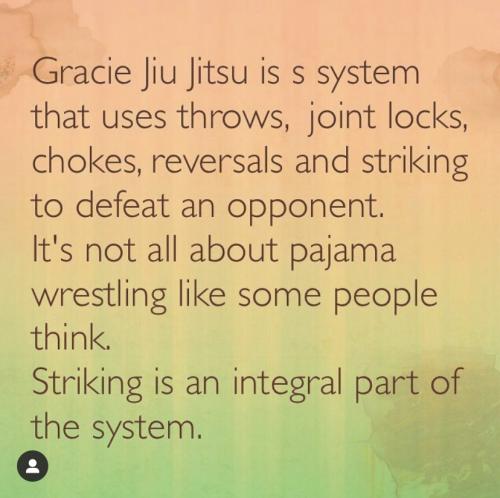
This is mine which I posted on insta awhile back. Don't really care for anyones opinion on it. Just answering the question. It is what it is.
 ML
MLBlue beltVerified
6 year(s) ago
Why limit yourself and the sport?
Open your mind. Be formless and shapeless like water. Adapt. Use no way as way and have no limitation as limitation. Absorb what is useful for you, reject what is useless and add what is specifically your own.
Situation and rules (competitoins rules, law of nature, bodymechanics and much more) forms what you can use
Noone puts Jiu-Jitsu in the corner. It always changing and taking different shapes.
Open your mind. Be formless and shapeless like water. Adapt. Use no way as way and have no limitation as limitation. Absorb what is useful for you, reject what is useless and add what is specifically your own.
Situation and rules (competitoins rules, law of nature, bodymechanics and much more) forms what you can use
Noone puts Jiu-Jitsu in the corner. It always changing and taking different shapes.
RDBlack belt 4th degreeVerified
6 year(s) ago
The only limit comes from a narrow view. I say learn and practice all the different aspects of this wonderful art. Jiu Jitsu is truly for everyone.
JMBlack beltVerified
6 year(s) ago
So any grappling sport is Jiu jitsu?
From my perspective, grappling is a component of jiu-jitsu - it is not jiu jitsu. Jiu-Jitsu is much larger. it is just that, strikes like the push kick or Palm strike are often used not to end your opponent but too manipulate them so that you can escape the situation or move to a submission. And, when it is confined to strictly grappling (sport jiu jitsu) it is focused on the submission. Control positions are only a step toward that end. Jiu jitsu also has a highly developed guard game. this is something you don't see it any other grappling art. So if you must separate Jiu-Jitsu from the others, I would say, it is to be found in the submission game and the guard.
JMBlack beltVerified
6 year(s) ago
Why limit yourself and the sport? Open your mind. Be formless and shapeless like water. Adapt. Use no way as way and have no limitation as limitation. Absorb what is useful for you, reject what is useless and add what is specifically your own. Situation and rules (competitoins rules, law of nature, bodymechanics and much more) forms what you can use Noone puts Jiu-Jitsu in the corner. It always changing and taking different shapes.
Hey, this is not a Kung Fu forum! Try sash-checker.com. hahaha...
Actually, I would venture to say we nearly all agree with your sentiment.
But I think, the question is, what makes Jiu-Jitsu jiu jitsu?
Actually, I would venture to say we nearly all agree with your sentiment.
But I think, the question is, what makes Jiu-Jitsu jiu jitsu?
RDBlack belt 4th degreeVerified
 JJ
JJBlack beltVerified
6 year(s) ago
Oh no you didn't! 'Sport' jiu jitsu are techniques that fall apart the minute we reintroduce kicks, punches, slams and don't force people to engage a grounded opponent. Those all being part of the way BJJ was done when it fought vale tudo on the beaches of Brazil. Butt scooting is the easiest example, it doesn't work in MMA and even an untrained opponent knows how to kick your teeth out from that position, on the street.
I've literally had some of my untrained but very physically fit old football friends try to kick and slap me while I'm in a guard position and they are standing and attacking and was able to hook sweep them basically every time to go straight to knee slice pass, underhook and have positional dominance.
I think it possible versus untrained athletic people. Obviously not the ideal situation...but I do think it is possible if someone is very technical from their back. Obviously they weren't trying to kill me. But they were trying to kick the shit out of me and smack me as hard as they can and trying to get past my guard so they could be in closer range to smack me more then the worst white belt spaz you have ever seen. lol
Also a thing I noticed is when they tried to kick me and slap me it made it even easier to get the sweep as it off balanced them or forced them to be closer in range for me to do what I wanted to do anyways. Even played around standing some and experimented with "attacking" by pulling guard straight into the hook sweep and again this is all against untrained people who have never grappled. The only time where it wasn't easy to sweep was when they were trying to avoid me by moving away from me and not being stationary or aggressive moving towards me and if they aren't moving towards me or being aggressive then they aren't really posing a threat.
Obviously in any non 1 on 1 scenario being on your ass is a horrible idea. But if it's 1 on 1 I still think it can be a very effective strategy.
I think it possible versus untrained athletic people. Obviously not the ideal situation...but I do think it is possible if someone is very technical from their back. Obviously they weren't trying to kill me. But they were trying to kick the shit out of me and smack me as hard as they can and trying to get past my guard so they could be in closer range to smack me more then the worst white belt spaz you have ever seen. lol
Also a thing I noticed is when they tried to kick me and slap me it made it even easier to get the sweep as it off balanced them or forced them to be closer in range for me to do what I wanted to do anyways. Even played around standing some and experimented with "attacking" by pulling guard straight into the hook sweep and again this is all against untrained people who have never grappled. The only time where it wasn't easy to sweep was when they were trying to avoid me by moving away from me and not being stationary or aggressive moving towards me and if they aren't moving towards me or being aggressive then they aren't really posing a threat.
Obviously in any non 1 on 1 scenario being on your ass is a horrible idea. But if it's 1 on 1 I still think it can be a very effective strategy.
Edited 6 year(s) ago
AKPurple beltVerified
6 year(s) ago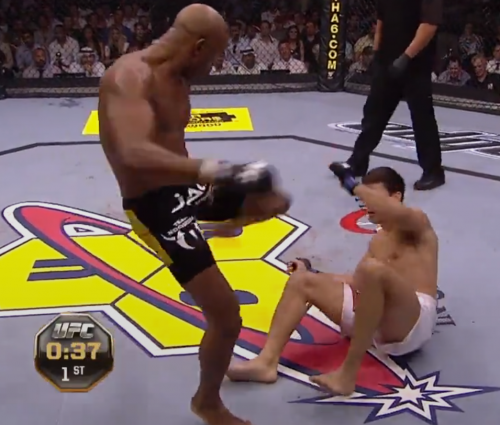
You have seen buttscooting in MMA :) My coach once 'won' (de-escalated and escaped) a multiple opponents streetfight scenario with a heelhook from bottom :D And would anyone say that buttscooting is a 'jiu-jitsu technique' that is really being taught and practiced? I don't think so...
I saw Demian Maia try it. It didn't go well...
 CB
CBBrown beltVerified
5 year(s) ago
I honestly just define this on hand from what you're going to learn from the majority of BJJ schools out there, meaning, grappling both with and without the gi with a focus on controlling your opponent on the ground and submissions. While there are schools that include striking, honestly speaking, they are in the extreme minority and are normally done as the MMA program in an Academy that teaches multiple disciplines. If I have to go to a specific school to learn something and can't learn it at most BJJ schools I visit, I just don't think it's honest to say that it's BJJ.
 M
MBrown beltVerified
5 year(s) ago
I honestly just define this on hand from what you're going to learn from the majority of BJJ schools out there, meaning, grappling both with and without the gi with a focus on controlling your opponent on the ground and submissions. While there are schools that include striking, honestly speaking, they are in the extreme minority and are normally done as the MMA program in an Academy that teaches multiple disciplines. If I have to go to a specific school to learn something and can't learn it at most BJJ schools I visit, I just don't think it's honest to say that it's BJJ.
Hy Chris, Maybe I don’t understand you correct because of language issues.
I have a different opinion about this.
Of course Jiu Jitsu is the art of control emphasizing grappling but still lots of, let’s call it more „traditional“ Jiu Jitsu schools (very often called Gracie Jiu Jitsu) include defending punches standing and on the ground in their standard curriculum. Of course they do „regular“ grappling too and do sparring and rolling or compete.
My friend and one of my coaches calls it „Complete Jiu Jitsu“.
Training MMA (as add on Programm) with context of winning and competition, trained athlete vs athlete, is different from the context of survival against punches to get away to a safe place ( bjj vs average guy).
So if you go to a Jiu Jitsu school that teaches Defending against punches too Instead of the majority of schools that teach grappling only, then in your definition the first one wouldn’t be BJJ?
Maybe I understood you wrong?
I have a different opinion about this.
Of course Jiu Jitsu is the art of control emphasizing grappling but still lots of, let’s call it more „traditional“ Jiu Jitsu schools (very often called Gracie Jiu Jitsu) include defending punches standing and on the ground in their standard curriculum. Of course they do „regular“ grappling too and do sparring and rolling or compete.
My friend and one of my coaches calls it „Complete Jiu Jitsu“.
Training MMA (as add on Programm) with context of winning and competition, trained athlete vs athlete, is different from the context of survival against punches to get away to a safe place ( bjj vs average guy).
So if you go to a Jiu Jitsu school that teaches Defending against punches too Instead of the majority of schools that teach grappling only, then in your definition the first one wouldn’t be BJJ?
Maybe I understood you wrong?
Edited 5 year(s) ago
CBBrown beltVerified
5 year(s) ago
Hi Marco,
I think the problem is more a lack of my communication skills, and my general laziness when writing up a forum post than your english skills.
My thoughts on the matter are simply a matter of terminology and effective use of language more than anything else.
To give a non BJJ example, look at Judo. Technically speaking, Judo includes knee bars and Atemi (striking). However, finding a school that teach them is relatively impossible. This is different from the current situation with leg grabs as this is a fairly recent change and most older Judoka still know and practice these techniques (a sort of Schrodinger's Judo if you will). But the leg locks and Atemi are more or less lost to time. There's documentation of them, but you'll almost never learn any of these techniques at a Judo Club, and even the ones that do, most likely learned them from sources outside of Judo. So even if you could learn striking and knee bars in a Judo Club, they're not really part of Judo in any real sense. If you're not going to be able to learn these things from the overwhelming majority of Judo Clubs, then you can't really say these techniques are Judo. There my be unique Judo Clubs that offer a broader curriculum, but they're the exception doing Judo plus xyz. This is a neutral statement. The xyz is not bad or even a problem, it's just not really Judo. Now, let's say that the rules of Judo change again and knee bars are reintroduced and the majority of Judo Clubs practice then again. Then Judo changes again.
Now, taking this back to BJJ. Let's say I open a BJJ academy and teach the typical BJJ program you'll get with most gyms. However, for the sake of hyperbole, I start every class with a lesson on lightsaber fighting. I don't think I'd have to argue that the lightsaber fighting isn't BJJ and is just something I came up with. Taking this a step further, let's say I do kenjutsu classes instead of lightsaber fighting. If you trace the history of BJJ far enough into the past, like how lots of people trace things back to Kano, there were actual sword fighting techniques in jujutsu which eventually became BJJ. But still, this wouldn't be BJJ and would still be something I included. My own special variation. Some might even think it would be better that way, but it would still be unique to me and not BJJ as a whole.
Originally, striking was part of BJJ just like leg locks had little emphasis. Back in the day, this was the consensus of BJJ back then. However, now things are different. Yes, you'll learn striking in some BJJ schools, but not in most, at least not as part of the BJJ class. When talking about the majority of BJJ schools, you're going to be talking about a grappling system with a focus on controlling the opponent on the ground and submitting them. The rest will be the xyz. Again, nothing bad, just not really BJJ.
To bring things back to the traditional Japanese Koryu traditions, unlike what many think, introducing one's own ideas into a specific school, say Shindo Yoshin Ryu, was perfectly normal. In fact, a man named Takamura did just that about 40 years ago and included several new aspects from his experience. However, he also made a point to not call his school simply Shindo Yoshin Ryu, but Takamura-ha Shindo Yoshin Ryu (basically the Takamura branch or version of Shindo Yoshin Ryu or Shindo Yoshin Ryu plus xyz from Takamura). Again, not a value statement, just intellectual honesty.
Ugh. I do carry on. Hope I was clear here.
I think the problem is more a lack of my communication skills, and my general laziness when writing up a forum post than your english skills.
My thoughts on the matter are simply a matter of terminology and effective use of language more than anything else.
To give a non BJJ example, look at Judo. Technically speaking, Judo includes knee bars and Atemi (striking). However, finding a school that teach them is relatively impossible. This is different from the current situation with leg grabs as this is a fairly recent change and most older Judoka still know and practice these techniques (a sort of Schrodinger's Judo if you will). But the leg locks and Atemi are more or less lost to time. There's documentation of them, but you'll almost never learn any of these techniques at a Judo Club, and even the ones that do, most likely learned them from sources outside of Judo. So even if you could learn striking and knee bars in a Judo Club, they're not really part of Judo in any real sense. If you're not going to be able to learn these things from the overwhelming majority of Judo Clubs, then you can't really say these techniques are Judo. There my be unique Judo Clubs that offer a broader curriculum, but they're the exception doing Judo plus xyz. This is a neutral statement. The xyz is not bad or even a problem, it's just not really Judo. Now, let's say that the rules of Judo change again and knee bars are reintroduced and the majority of Judo Clubs practice then again. Then Judo changes again.
Now, taking this back to BJJ. Let's say I open a BJJ academy and teach the typical BJJ program you'll get with most gyms. However, for the sake of hyperbole, I start every class with a lesson on lightsaber fighting. I don't think I'd have to argue that the lightsaber fighting isn't BJJ and is just something I came up with. Taking this a step further, let's say I do kenjutsu classes instead of lightsaber fighting. If you trace the history of BJJ far enough into the past, like how lots of people trace things back to Kano, there were actual sword fighting techniques in jujutsu which eventually became BJJ. But still, this wouldn't be BJJ and would still be something I included. My own special variation. Some might even think it would be better that way, but it would still be unique to me and not BJJ as a whole.
Originally, striking was part of BJJ just like leg locks had little emphasis. Back in the day, this was the consensus of BJJ back then. However, now things are different. Yes, you'll learn striking in some BJJ schools, but not in most, at least not as part of the BJJ class. When talking about the majority of BJJ schools, you're going to be talking about a grappling system with a focus on controlling the opponent on the ground and submitting them. The rest will be the xyz. Again, nothing bad, just not really BJJ.
To bring things back to the traditional Japanese Koryu traditions, unlike what many think, introducing one's own ideas into a specific school, say Shindo Yoshin Ryu, was perfectly normal. In fact, a man named Takamura did just that about 40 years ago and included several new aspects from his experience. However, he also made a point to not call his school simply Shindo Yoshin Ryu, but Takamura-ha Shindo Yoshin Ryu (basically the Takamura branch or version of Shindo Yoshin Ryu or Shindo Yoshin Ryu plus xyz from Takamura). Again, not a value statement, just intellectual honesty.
Ugh. I do carry on. Hope I was clear here.



