
Rules for main forums
- Be nice
- No advertisement
- No events
- No fundraisers
- No topics asking for votes
- Only posts related to Brazilian Jiu Jitsu
NCAA Wrestling questions
6 year(s) ago • 757 views • 10 replies
 AK
AKPurple beltVerified
6 year(s) ago
I'm trying to convert the implications of some US College wrestling (NCAA / folkstyle ) stats into BJJ. Never having wrestled, i'd appreciate if anyone who knows the sport could confirm or deny my interpretations are correct.
50.4% of points were scored from a neutral position. 34.8% bottom, 12.8% top and 2% penalties.
1. "Bottom position" here refers to the referee's position which is pretty similar to a BJJ 'turtle' with the top guy having one underhook?
Of the 12.8% of top points, 75% were awarded for "riding time"
2. "Riding time" refers to preventing the bottom person escaping for 30 seconds and is worth 1 point?
Of the 34.8% of bottom points. 76.2% were awarded for "stand up"
3. a "stand up" could score as an escape (1 point) or a reversal (2 points), but the escape is more likely?
The 50.4% of points scored from neutral would be takedowns or near falls.
4. Not all takedowns and near falls in wrestling would score points in BJJ, but all BJJ point scoring takedowns would score in wrestling?
50.4% of points were scored from a neutral position. 34.8% bottom, 12.8% top and 2% penalties.
1. "Bottom position" here refers to the referee's position which is pretty similar to a BJJ 'turtle' with the top guy having one underhook?
Of the 12.8% of top points, 75% were awarded for "riding time"
2. "Riding time" refers to preventing the bottom person escaping for 30 seconds and is worth 1 point?
Of the 34.8% of bottom points. 76.2% were awarded for "stand up"
3. a "stand up" could score as an escape (1 point) or a reversal (2 points), but the escape is more likely?
The 50.4% of points scored from neutral would be takedowns or near falls.
4. Not all takedowns and near falls in wrestling would score points in BJJ, but all BJJ point scoring takedowns would score in wrestling?
 JA
JABlack beltVerified
6 year(s) ago
1. 'Bottom position' here refers to the referee's position which is pretty similar to a BJJ 'turtle' with the top guy having one underhook?
In Refree's position top man has no hooks, but an arm around wait and another hand on the near elbow. The close knee is kneeling and the other knee is up behind the butt. I always liked pinching with my knee and putting my ear on the bottom guy's back...
https://www.youtube.com/w[...]A4NmzhCJGI
https://www.youtube.com/w[...]A4NmzhCJGI
 BM
BMBlack belt 1st degreeVerified

6 year(s) ago
I wrestled in high school, and 3 yrs in college (NCAA Div 2). Hope this helps...
1) Q: "Bottom position" here refers to the referee's position which is pretty similar to a BJJ 'turtle' with the top guy having one underhook?
A: The referee's position is one example of a bottom position; basically any time you are on bottom and you can stand up and face your opponent in a neutral position (usually the feet) then you score a point for an escape.
2) Q: "Riding time" refers to preventing the bottom person escaping for 30 seconds and is worth 1 point?
A: No. Simply put, at the end of the match, whoever maintained top position the longest is awarded points for riding time. This was something they introduced during my last year of college wrestling, but from what I recall you have to have controlled on top for at least a minute to score points.
3) Q: a "stand up" could score as an escape (1 point) or a reversal (2 points), but the escape is more likely?
A: exactly.
4) Q: Not all takedowns and near falls in wrestling would score points in BJJ, but all BJJ point scoring takedowns would score in wrestling?
A: Like 98% pretty much yes, but not necessarily. One small exception to this rule would be if you took someone down to like a "guard" position, you had "control" as the "guard passer", you wouldn't get points until you established "side control" or "top turtle" or something like that. This wouldn't be a very common situation in wrestling, but it would be a possibility. A super simple way to think about wrestling takedowns is that any time you achieve a top position from standing position, you are awarded points in wrestling, and the top position is not secured until you are around behind them (like referee's position/"turtle").
1) Q: "Bottom position" here refers to the referee's position which is pretty similar to a BJJ 'turtle' with the top guy having one underhook?
A: The referee's position is one example of a bottom position; basically any time you are on bottom and you can stand up and face your opponent in a neutral position (usually the feet) then you score a point for an escape.
2) Q: "Riding time" refers to preventing the bottom person escaping for 30 seconds and is worth 1 point?
A: No. Simply put, at the end of the match, whoever maintained top position the longest is awarded points for riding time. This was something they introduced during my last year of college wrestling, but from what I recall you have to have controlled on top for at least a minute to score points.
3) Q: a "stand up" could score as an escape (1 point) or a reversal (2 points), but the escape is more likely?
A: exactly.
4) Q: Not all takedowns and near falls in wrestling would score points in BJJ, but all BJJ point scoring takedowns would score in wrestling?
A: Like 98% pretty much yes, but not necessarily. One small exception to this rule would be if you took someone down to like a "guard" position, you had "control" as the "guard passer", you wouldn't get points until you established "side control" or "top turtle" or something like that. This wouldn't be a very common situation in wrestling, but it would be a possibility. A super simple way to think about wrestling takedowns is that any time you achieve a top position from standing position, you are awarded points in wrestling, and the top position is not secured until you are around behind them (like referee's position/"turtle").
AKPurple beltVerified
6 year(s) ago
I wrestled in high school, and 3 yrs in college (NCAA Div 2). Hope this helps... 1) Q: 'Bottom position' here refers to the referee's position which is pretty similar to a BJJ 'turtle' with the top guy having one underhook? A: The referee's position is one example of a bottom position; basically any time you are on bottom and you can stand up and face your opponent in a neutral position (usually the feet) then you score a point for an escape. 2) Q: 'Riding time' refers to preventing the bottom person escaping for 30 seconds and is worth 1 point? A: No. Simply put, at the end of the match, whoever maintained top position the longest is awarded points for riding time. This was something they introduced during my last year of college wrestling, but from what I recall you have to have controlled on top for at least a minute to score points. 3) Q: a 'stand up' could score as an escape (1 point) or a reversal (2 points), but the escape is more likely? A: exactly. 4) Q: Not all takedowns and near falls in wrestling would score points in BJJ, but all BJJ point scoring takedowns would score in wrestling? A: Like 98% pretty much yes, but not necessarily. One small exception to this rule would be if you took someone down to like a 'guard' position, you had 'control' as the 'guard passer', you wouldn't get points until you established 'side control' or 'top turtle' or something like that. This wouldn't be a very common situation in wrestling, but it would be a possibility. A super simple way to think about wrestling takedowns is that any time you achieve a top position from standing position, you are awarded points in wrestling, and the top position is not secured until you are around behind them (like referee's position/'turtle').
Thanks, so regarding Q1, if a wrestler shot in for a takedown and the other person sprawled on top of them, but the bottom person got back to neutral does that score? I watched a Kurt Angle match vs Mark Kerr and Kurt was doing that a lot but not scoring?
BMBlack belt 1st degreeVerified
6 year(s) ago
Thanks, so regarding Q1, if a wrestler shot in for a takedown and the other person sprawled on top of them, but the bottom person got back to neutral does that score? I watched a Kurt Angle match vs Mark Kerr and Kurt was doing that a lot but not scoring?
Exactly. The person who sprawled wouldn't get any points until they made their way to the other person's back (like a "referee's position"...).
JABlack beltVerified
6 year(s) ago
1. 'Bottom position' here refers to the referee's position which is pretty similar to a BJJ 'turtle' with the top guy having one underhook?
In Refree's position top man has no hooks, but an arm around wait and another hand on the near elbow. The close knee is kneeling and the other knee is up behind the butt. I always liked pinching with my knee and putting my ear on the bottom guy's back...
https://www.youtube.com/w[...]A4NmzhCJGI
https://www.youtube.com/w[...]A4NmzhCJGI
AKPurple beltVerified
5 year(s) ago
In Refree's position top man has no hooks, but an arm around wait and another hand on the near elbow. The close knee is kneeling and the other knee is up behind the butt. I always liked pinching with my knee and putting my ear on the bottom guy's back... https://www.youtube.com/w[...]A4NmzhCJGI
Understood. Do you ever utilise an inside cradle position in BJJ? It seems like something which could be used to set up leg attacks but i haven't really experimented with it yet.
AKPurple beltVerified
5 year(s) ago
Exactly. The person who sprawled wouldn't get any points until they made their way to the other person's back (like a 'referee's position'...).
Is an inside cradle scored as a "near fall"? Do you think it's got much utility in BJJ?
AKPurple beltVerified
5 year(s) ago
Exactly. The person who sprawled wouldn't get any points until they made their way to the other person's back (like a 'referee's position'...).
Is that "short offense"?
BMBlack belt 1st degreeVerified
5 year(s) ago
Is an inside cradle scored as a 'near fall'? Do you think it's got much utility in BJJ?
The inside cradle, if executed properly, would be able to produce nearfall points, or you could pin someone with it. A nearfall is just a fancy way to say an "almost pin", or "back exposure" maybe is more appropriate; basically, when you're trying to pin someone, you can get points for the time that their back is exposed to the ground. You get 2 points for 3 seconds, and 3 points for 5 seconds.
When I first started training bjj, I used the cradle as a way to pass, but eventually discovered that the standard BJJ passes are more efficient in most cases. I have a student now who uses the far side cradle to pass and it's fairly effective on me so I'm starting to look at that again. Otherwise, I haven't used it since like 2006.
And to answer your other question, yes, that position described earlier is "short offense".
When I first started training bjj, I used the cradle as a way to pass, but eventually discovered that the standard BJJ passes are more efficient in most cases. I have a student now who uses the far side cradle to pass and it's fairly effective on me so I'm starting to look at that again. Otherwise, I haven't used it since like 2006.
And to answer your other question, yes, that position described earlier is "short offense".
AKPurple beltVerified
5 year(s) ago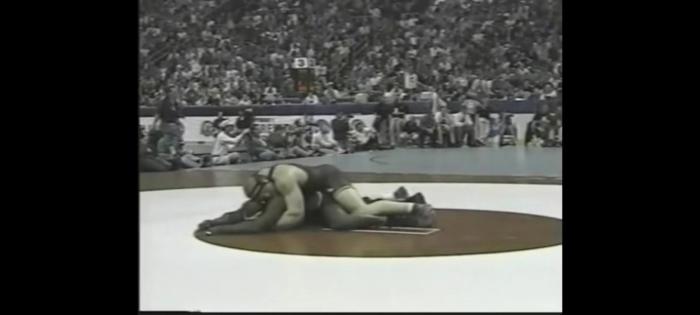
The inside cradle, if executed properly, would be able to produce nearfall points, or you could pin someone with it. A nearfall is just a fancy way to say an 'almost pin', or 'back exposure' maybe is more appropriate; basically, when you're trying to pin someone, you can get points for the time that their back is exposed to the ground. You get 2 points for 3 seconds, and 3 points for 5 seconds. When I first started training bjj, I used the cradle as a way to pass, but eventually discovered that the standard BJJ passes are more efficient in most cases. I have a student now who uses the far side cradle to pass and it's fairly effective on me so I'm starting to look at that again. Otherwise, I haven't used it since like 2006. And to answer your other question, yes, that position described earlier is 'short offense'.
See how the bottom guy has deliberately gone flat to the floor from the referee position. Would he do that because he didn't think he could make the escape and is waiting for the time to run out?



