
Rules for main forums
- Be nice
- No advertisement
- No events
- No fundraisers
- No topics asking for votes
- Only posts related to Brazilian Jiu Jitsu
The Man Who Introduced Brazil to Jiu-Jitsu, Irving Hancock
3 year(s) ago • 6943 views • 3 replies
 JS
JSBlack belt 3rd degreeVerified

3 year(s) ago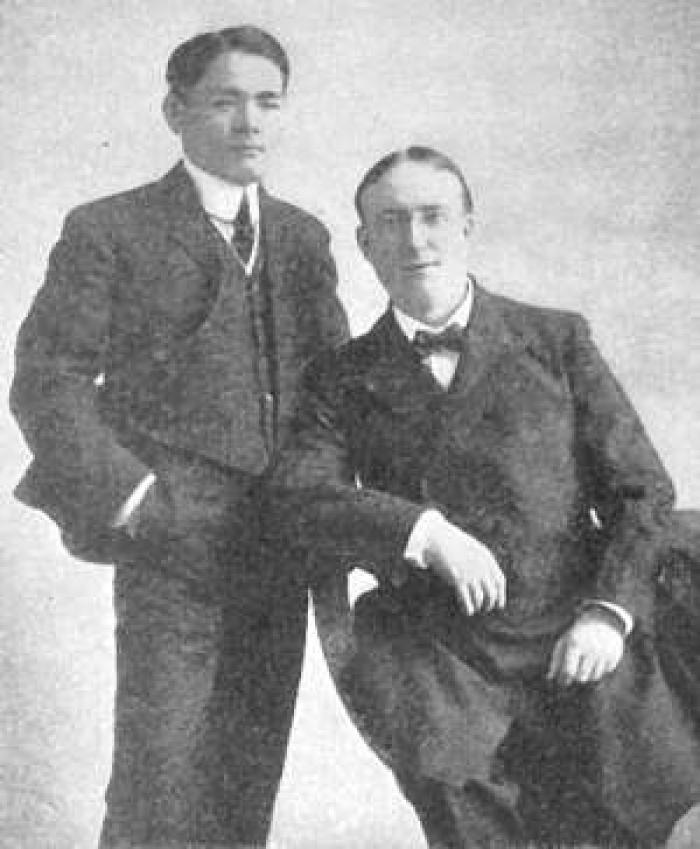
While Maeda’s time in Brazil (1914 - 1941) was substantial and led to the growing popularity of combat sports and combat sport competitions, Brazilians practiced Jiu-Jitsu prior to his arrival. The person that did introduce Brazil to the Japanese art, was most likely not Japanese, but actually an American.
Irving Hancock was an American author who wrote dozens of books. In the beginning of the 20th century, he befriended a traveling Japanese fighter named Katsukuma Higashi in New York City. While Higashi’s qualifications and expertise are hard to verify, it appears that he had at least some training in traditional Japanese Jiu-Jitsu. Hancock chose to create two martial arts instructional books with Higashi: Jiu-Jitsu Combat Tricks (1904) and The Complete Kano Jiu-Jitsu (1905). Interestingly, while the two leveraged Jigoro Kano’s name for their second book, it appears unlikely that Higashi ever trained in Kano Jiu-Jitsu/Judo.
While Hancock and Higashi were in New York writing and taking photographs for their Jiu-Jitsu instructional manuals, nearly 7,000 miles away, Japan was locked in a war with Russia. The Russo-Japanese war lasted from 1904 to 1905 and related to territorial control of Manchuria and Korea. Surprisingly, Japan resoundingly defeated the Russian military and immediately raised its profile on the world stage. The western world became fascinated with Japan and its culture and how such a small nation could so quickly defeat a global power in combat. This, in turn, led to significant demand across North America, South America and Europe for knowledge into the Japanese fighting arts. While much of the war was fought with naval assets, articles at the time attributed the Japanese soldiers’ and sailors’ success to their Jiu-Jitsu training.
Hancock’s books were some of the first books written in English on the subject of Japanese hand to hand combat techniques. They were quickly translated into a myriad of languages and found their way to Brazil.
Read more about Irving Hancock and the origins of BJJ at BJJHistory.org.
Follow me on Instagram at historyofbjj
Thanks,
Josh
Irving Hancock was an American author who wrote dozens of books. In the beginning of the 20th century, he befriended a traveling Japanese fighter named Katsukuma Higashi in New York City. While Higashi’s qualifications and expertise are hard to verify, it appears that he had at least some training in traditional Japanese Jiu-Jitsu. Hancock chose to create two martial arts instructional books with Higashi: Jiu-Jitsu Combat Tricks (1904) and The Complete Kano Jiu-Jitsu (1905). Interestingly, while the two leveraged Jigoro Kano’s name for their second book, it appears unlikely that Higashi ever trained in Kano Jiu-Jitsu/Judo.
While Hancock and Higashi were in New York writing and taking photographs for their Jiu-Jitsu instructional manuals, nearly 7,000 miles away, Japan was locked in a war with Russia. The Russo-Japanese war lasted from 1904 to 1905 and related to territorial control of Manchuria and Korea. Surprisingly, Japan resoundingly defeated the Russian military and immediately raised its profile on the world stage. The western world became fascinated with Japan and its culture and how such a small nation could so quickly defeat a global power in combat. This, in turn, led to significant demand across North America, South America and Europe for knowledge into the Japanese fighting arts. While much of the war was fought with naval assets, articles at the time attributed the Japanese soldiers’ and sailors’ success to their Jiu-Jitsu training.
Hancock’s books were some of the first books written in English on the subject of Japanese hand to hand combat techniques. They were quickly translated into a myriad of languages and found their way to Brazil.
Read more about Irving Hancock and the origins of BJJ at BJJHistory.org.
Follow me on Instagram at historyofbjj
Thanks,
Josh
 JM
JMBlack belt 2nd degreeVerified
3 year(s) ago
Cool beans.
Did it stick in anyway though?
There are also records pre WW2 about jiu jitsu being introduced in Estonia (via British) e.g. for police forces. However there is no record of it sticking in any way besides a few newspaper stories and one book AFAIK.
So Estonia did actually not get a real introduction to Judo until the 80s really, bastardized "traditional" ju-jutsu until 90s and BJJ until 00s.
(There was Sambo in the 70s but it was mostly Russians practicing it and basically no cross/carryover with other arts until now when it has virtually died out. A strong history of wrestling though and influence on all of the above until now. Rich history of catch as well pre WW1 but this vanished shortly after due dominance of Olympic Wrestling.)
Did it stick in anyway though?
There are also records pre WW2 about jiu jitsu being introduced in Estonia (via British) e.g. for police forces. However there is no record of it sticking in any way besides a few newspaper stories and one book AFAIK.
So Estonia did actually not get a real introduction to Judo until the 80s really, bastardized "traditional" ju-jutsu until 90s and BJJ until 00s.
(There was Sambo in the 70s but it was mostly Russians practicing it and basically no cross/carryover with other arts until now when it has virtually died out. A strong history of wrestling though and influence on all of the above until now. Rich history of catch as well pre WW1 but this vanished shortly after due dominance of Olympic Wrestling.)
Edited 3 year(s) ago
JSBlack belt 3rd degreeVerified
3 year(s) ago
Jorgen,
Thanks. Great question. I cover it in the other articles on the site, but the quick version is:
- Brazilians learned from the books, and at least one Brazilian, Mario Aleixo, opened a school and taught Jiu-Jitsu from what he learned in the books. This was the first Jiu-Jitsu school in Brazil and was there a year before Maeda arrived in Brazil.
- Aleixo became a rival with the Gracies and George had a Vale Tudo fight with him. Aleixo lost badly and basically faded into history.
That fight had a lot of significance as it established the value of hard training and training under qualified and experienced instructors as opposed to book learning. That value structure continues to this day.
Josh
Thanks. Great question. I cover it in the other articles on the site, but the quick version is:
- Brazilians learned from the books, and at least one Brazilian, Mario Aleixo, opened a school and taught Jiu-Jitsu from what he learned in the books. This was the first Jiu-Jitsu school in Brazil and was there a year before Maeda arrived in Brazil.
- Aleixo became a rival with the Gracies and George had a Vale Tudo fight with him. Aleixo lost badly and basically faded into history.
That fight had a lot of significance as it established the value of hard training and training under qualified and experienced instructors as opposed to book learning. That value structure continues to this day.
Josh
JMBlack belt 2nd degreeVerified
3 year(s) ago
I think Brazil thug and street fighting culture was what elevated jiu jitsu - they had to put emphasis on effective sparring and likely training was more individualized compared to standardized judo or sportified wrestling during the same era (1930s to 1980s).



