
Rules for main forums
- Be nice
- No advertisement
- No events
- No fundraisers
- No topics asking for votes
- Only posts related to Brazilian Jiu Jitsu
Underhook Mechanics
2 year(s) ago • 955 views • 17 replies
 AK
AKPurple beltVerified
2 year(s) ago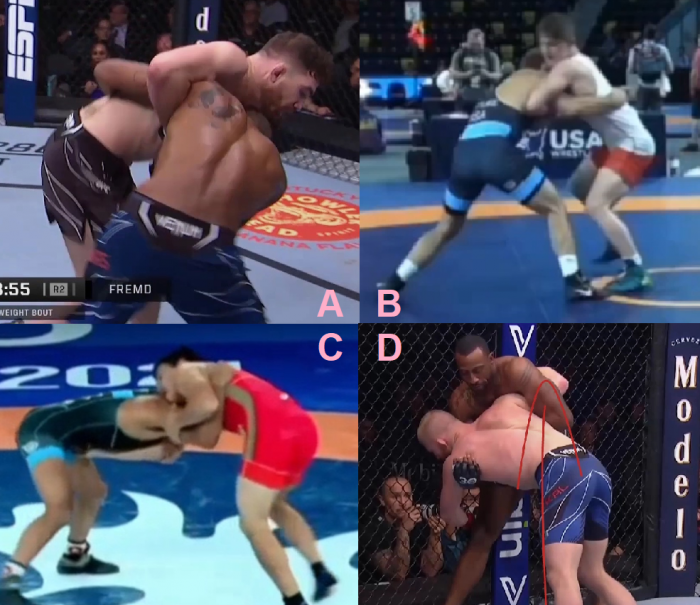
If you were looking at a static picture of 2 standing grapplers, 1 with an underhook and 1 with an whizzer or outside tie, what visual clues could you identify that would indicate who had the better position to initiate a takedown?
I realise the answer may vary depending on whether their hips and chest are close, so i've put 4 scenarios into this picture, please state A, B, C, D to identify which scenario your comment applies to.
For example, in A, I can see the fighter with a whizzer has his elbow up and wrist near the hip of the underhooking opponent, this suggests to me that he can exert a lot of torque onto the underhooking shoulder and therefore has the better position. However i'm lacking a unifed set of principles to extrapolate to the other scenarios.
I appreciate that when we have an underhook, we would generally prefer to be chest to chest with our opponent, but that's harder to enter directly, so often we have to start with a shallow underhook, like in 'C' before we can advance
I realise the answer may vary depending on whether their hips and chest are close, so i've put 4 scenarios into this picture, please state A, B, C, D to identify which scenario your comment applies to.
For example, in A, I can see the fighter with a whizzer has his elbow up and wrist near the hip of the underhooking opponent, this suggests to me that he can exert a lot of torque onto the underhooking shoulder and therefore has the better position. However i'm lacking a unifed set of principles to extrapolate to the other scenarios.
I appreciate that when we have an underhook, we would generally prefer to be chest to chest with our opponent, but that's harder to enter directly, so often we have to start with a shallow underhook, like in 'C' before we can advance
 R
RBlack belt 1st degreeVerified

2 year(s) ago
I think a lot of it has to do with who controls more inside space, and/or who has the better angle or elevation for what they're trying to achieve.
Simply looking at a static picture can prove difficult to decide which is winning in that exchange.
If a fighter has an undertook and has their head and/or hip inside, odds are they are being more effective.
Simply looking at a static picture can prove difficult to decide which is winning in that exchange.
If a fighter has an undertook and has their head and/or hip inside, odds are they are being more effective.
 RG
RGBlack belt 1st degreeVerified
2 year(s) ago
It’s a good question, and the answer is “it depends.” lol seriously though. In the context of takedowns esp no gi, underhook dynamics change and shift drastically in milliseconds due to the dynamic and explosive nature of no gi/wrestling. So just because you might be “winning” and underhook battle, you could end up in a losing position in a second. What I mean is take picture A for example, depending on height and body type, an uchi mata can be thrown with the underhook, you can do a body fold take down if you get chest to chest, and you can also level change for leg grabs if the opponent doesn’t overhook or whizzer properly. On the other hand the guy with the overhook can use his whizzer to break down the posture of the undercooking guy and force a harai goshi or uchi mata as well.
The deciding factor is subtle in whose controlling space and posture of their opponent, and if possible also controlling the far side arm. And these minute details can change in a milisecond. So I guess it “depends” lol. Sorry for not being of anymore help.
The deciding factor is subtle in whose controlling space and posture of their opponent, and if possible also controlling the far side arm. And these minute details can change in a milisecond. So I guess it “depends” lol. Sorry for not being of anymore help.
Edited 2 year(s) ago
 TR
TRBlack beltVerified
2 year(s) ago
In my opinion the main thing when underhooking someone is to rotate your elbow up so it is harder for them to push down your shoulder. Rotating your elbow up and grabbing the opposite side armpit or feeding opponents lapel on your hand, while same time using your head (head close to the chest/neck).
AKPurple beltVerified
2 year(s) ago
In my opinion the main thing when underhooking someone is to rotate your elbow up so it is harder for them to push down your shoulder. Rotating your elbow up and grabbing the opposite side armpit or feeding opponents lapel on your hand, while same time using your head (head close to the chest/neck).
Yes this is part of my confusion, elbow up is usually good for both the person with the underhook or the whizzer. It's just that there are some exceptions where you can still have a powerful underhook and elbow pointing straight down at the floor (you need to be chest to chest though). I'm just not sure how to explain why that works when most of the time, elbow up is preferable.
For a whizzer, making a triangle shape between your elbow, shoulder and hand is good. For your humerus to bar theirs, elbow up is going to add gravity into the equation making it stronger (i think)
For a whizzer, making a triangle shape between your elbow, shoulder and hand is good. For your humerus to bar theirs, elbow up is going to add gravity into the equation making it stronger (i think)
Edited 2 year(s) ago
AKPurple beltVerified
2 year(s) ago
On the other hand the guy with the overhook can use his whizzer to break down the posture of the undercooking guy and force a harai goshi or uchi mata as well.
Yes, i've got a compliation of harai goshi and uchi mata's done in the UFC and the person pulling it off nearly always gets their elbow high (on the whizzer)
AKPurple beltVerified
2 year(s) ago
I think a lot of it has to do with who controls more inside space, and/or who has the better angle or elevation for what they're trying to achieve. Simply looking at a static picture can prove difficult to decide which is winning in that exchange. If a fighter has an undertook and has their head and/or hip inside, odds are they are being more effective.
In this context, i'm a bit fuzzy defining inside space. We have different attacks if we take an underhook and have our head on the same side, or far side. I've also heard high level guys saying they prefer head on the opposite side and it's better in Greco when my priority is trying to get to double underhooks. I'm not totally sure if i have more or less of the inside space in under / over (head on opposite side), assuming my underhook is better than theirs, compared to having an underhook and head on the same side. Certainly i feel they can't really do much to me when the head is same side, but attack wise i mainly want to go for the legs or enter a front headlock if they hide their legs back. Maybe the lack of leg attacks in Greco explains the preference for head on the opposite side to the underhook.
RBlack belt 1st degreeVerified
2 year(s) ago
In this context, i'm a bit fuzzy defining inside space. We have different attacks if we take an underhook and have our head on the same side, or far side. I've also heard high level guys saying they prefer head on the opposite side and it's better in Greco when my priority is trying to get to double underhooks. I'm not totally sure if i have more or less of the inside space in under / over (head on opposite side), assuming my underhook is better than theirs, compared to having an underhook and head on the same side. Certainly i feel they can't really do much to me when the head is same side, but attack wise i mainly want to go for the legs or enter a front headlock if they hide their legs back. Maybe the lack of leg attacks in Greco explains the preference for head on the opposite side to the underhook.
I was using head on the same side as an example. Surely there are numerous attack options from various grips and positions. However, if I control and occupy more inside space than you, I'm likely in a dominant position or have more options afforded to me. So think about if I had an underhook, head in the pocket on the same side as the underhook, and my leg is inside on the same side, with my hip in against yours. I can hit shots, hip throws, inside trips, foot sweeps, etc. Versus how many options exist as I gradually lose one of those at a time.
If you have a strong overhook on me, and inside hip position/head position, you are still threatening. Does that make sense?
If you have a strong overhook on me, and inside hip position/head position, you are still threatening. Does that make sense?
 JC
JCPurple beltVerified
2 year(s) ago
I think whether or not they are moving has a lot to do with it as well. Any given position may or may not be as good or bad as shown in a still photo depending on which direction the action is moving.
AKPurple beltVerified
2 year(s) ago
I was using head on the same side as an example. Surely there are numerous attack options from various grips and positions. However, if I control and occupy more inside space than you, I'm likely in a dominant position or have more options afforded to me. So think about if I had an underhook, head in the pocket on the same side as the underhook, and my leg is inside on the same side, with my hip in against yours. I can hit shots, hip throws, inside trips, foot sweeps, etc. Versus how many options exist as I gradually lose one of those at a time. If you have a strong overhook on me, and inside hip position/head position, you are still threatening. Does that make sense?
But if we're in under /over, both have 1 underhook and 1 overtie, we have the same amount of inside space? But if one of us has a deep underhook right in the other persons armpit, and the other just has a low and shallow underhook, then the first person is doing significantly better. Did the underhook difference alone change the dynamics of the inside space, because everything else was mirrored?
RBlack belt 1st degreeVerified
2 year(s) ago
But if we're in under /over, both have 1 underhook and 1 overtie, we have the same amount of inside space? But if one of us has a deep underhook right in the other persons armpit, and the other just has a low and shallow underhook, then the first person is doing significantly better. Did the underhook difference alone change the dynamics of the inside space, because everything else was mirrored?
I think it then comes down to movement and who utilizes it better. And yes, a shallow/low underhook would likely hinder that person from being as effective as the one with a deeper underhook if that's the only difference in grip and body positioning. I think the concept of winning/controlling inside position goes deeper than just having body parts occupy that space - it includes effectively manipulating it. So just having an underhook vs. having an EFFECTIVE underhook.
You can get as specific as - if I have a high/deep underhook and I flatten my palm on your shoulder blade and flare my elbow, it's likely more effective in mitigating the whizzer on the corresponding side than if I just shoot my underhook deep but allow my elbow to fall against you rib cage. There are times when both are effective, but one is probably superior to the other in specific application.
All of the nuance takes us back to what a lo have said regarding the need for movement to dictate who is winning that particular problem. Pictures make it tough to define for sure.
You can get as specific as - if I have a high/deep underhook and I flatten my palm on your shoulder blade and flare my elbow, it's likely more effective in mitigating the whizzer on the corresponding side than if I just shoot my underhook deep but allow my elbow to fall against you rib cage. There are times when both are effective, but one is probably superior to the other in specific application.
All of the nuance takes us back to what a lo have said regarding the need for movement to dictate who is winning that particular problem. Pictures make it tough to define for sure.
 MG
MGBlack beltVerified
2 year(s) ago
Hey Alex!
Static pictures are truly a horrible indicator of anything to be honest. As Randy explained, the visual clues that identify who has the better position are head position and free arm control (i.e. inside control). A better position is just the beginning, movement to draw out mistakes and/or unbalancing your opponent is also key. Remember though, like in life you can do everything right and still lose.
Why would having the hips and chest close change who had the better position to initiate a takedown? The only thing that changes is where you need to put your focus. Closer hips and chest means my free arm positioning is more important. Far hips and chest means my leg positioning is more important.
If you have a Whizzer having your elbow pointing higher is definitely not a thing. Lock down on your opponent’s underhook period. Sure your elbow will point higher the more you bend at the waist. Like when you initiate a No-Gi Uchi Mata (sign) or Overhook Kickout you bend at the waist. The closer your elbow is to your rib cage the stronger you are in that position.
If you secure an underhook most people would generally prefer to cut an 90 angle. You would only prefer chest to chest if your goal is something like double underhooks. But even then cutting to 90 degrees, dominating inside control, and then entering double underhooks is way better.
Never start anything with a shallow underhook, it’s way too easy to get thrown or submit someone with a shallow underhook.
Static pictures are truly a horrible indicator of anything to be honest. As Randy explained, the visual clues that identify who has the better position are head position and free arm control (i.e. inside control). A better position is just the beginning, movement to draw out mistakes and/or unbalancing your opponent is also key. Remember though, like in life you can do everything right and still lose.
Why would having the hips and chest close change who had the better position to initiate a takedown? The only thing that changes is where you need to put your focus. Closer hips and chest means my free arm positioning is more important. Far hips and chest means my leg positioning is more important.
If you have a Whizzer having your elbow pointing higher is definitely not a thing. Lock down on your opponent’s underhook period. Sure your elbow will point higher the more you bend at the waist. Like when you initiate a No-Gi Uchi Mata (sign) or Overhook Kickout you bend at the waist. The closer your elbow is to your rib cage the stronger you are in that position.
If you secure an underhook most people would generally prefer to cut an 90 angle. You would only prefer chest to chest if your goal is something like double underhooks. But even then cutting to 90 degrees, dominating inside control, and then entering double underhooks is way better.
Never start anything with a shallow underhook, it’s way too easy to get thrown or submit someone with a shallow underhook.
 J
JBlack belt 2nd degreeVerified
2 year(s) ago
Here’s what I learned about the underhook after a couple of seminars with Randy Couture in the early 2000s:
(1) You want the palm of your underhooking hand on your opponent’s deltoid. If it’s on his trap or his back, it’s not deep enough.
(2) You want the elbow of your underhooking arm raised so that you elevate your opponent’s underhooked elbow. This kills his whizzer and disrupts his base, forcing him to lean forward.
(3) You need to close the space between your body and his so that he can’t whizzer effectively or overwrap your arm and crank your shoulder (a bit like an Americana). Do this by stepping your hip and ribs close to his hip and ribs to close the space between your bodies.
(4) You need dominant head position. Drive the hairline of your forehead into the side of his mandible to keep him from moving his head to your underhook side, which will neutralize the position.
(5) Control the far wrist with your non-underhooking hand so that he can’t use it to escape.
These tips have served me well. I throw a lot of no-gi judo throws from this position, like uchi mata and tai otoshi.
Burton Richardson covers a lot of this in his Clinch for the Street video series. He and Randy have been friends for a long time, which is how I got to train with Randy.
(1) You want the palm of your underhooking hand on your opponent’s deltoid. If it’s on his trap or his back, it’s not deep enough.
(2) You want the elbow of your underhooking arm raised so that you elevate your opponent’s underhooked elbow. This kills his whizzer and disrupts his base, forcing him to lean forward.
(3) You need to close the space between your body and his so that he can’t whizzer effectively or overwrap your arm and crank your shoulder (a bit like an Americana). Do this by stepping your hip and ribs close to his hip and ribs to close the space between your bodies.
(4) You need dominant head position. Drive the hairline of your forehead into the side of his mandible to keep him from moving his head to your underhook side, which will neutralize the position.
(5) Control the far wrist with your non-underhooking hand so that he can’t use it to escape.
These tips have served me well. I throw a lot of no-gi judo throws from this position, like uchi mata and tai otoshi.
Burton Richardson covers a lot of this in his Clinch for the Street video series. He and Randy have been friends for a long time, which is how I got to train with Randy.
AKPurple beltVerified
2 year(s) ago
Never start anything with a shallow underhook, it’s way too easy to get thrown or submit someone with a shallow underhook.
Thanks for the reply, i'm doing some training tomorrow that I need to try some stuff before replying to the other comments. However, i'd recommend the second half of this match as an example of the value of shallow underhooks, naturally we'd prefer a deep underhook but it's less and less realistic to enter directly as your opponents skill level increases: https://www.youtube.com/w[...]_Eu-O4_2UU
I chose this match because it's particually interesting how Zhumashbek is able to shut down the freestyle attacks with his Greco-Roman.
I chose this match because it's particually interesting how Zhumashbek is able to shut down the freestyle attacks with his Greco-Roman.
MGBlack beltVerified
2 year(s) ago
I absolutely love how in-depth you get with techniques. I think I need to clarify the definition of shallow underhook because it changes based on the style you are referring to.
In wrestling, if you have your hand on the shoulder blade and you can move / control your opponent then you have yourself an underhook, often called a shallow underhook.
In BJJ, an underhook becomes a shallow underhook when your opponent can reach and control your elbow line. Submissions like Ude Garami (MIR Lock / Americana) and Ude Gatame (Straight Arm Lock) really change the game.
Looks like Zhumashbek was really clubbing and punching that underhook in during the match, especially in the second half. Besides Liu’s double in the first Zhumashbek really did shut down Liu’s leg attacks and almost got a lift at 2:45. Also, 100% it’s harder to get deep underhooks on higher skilled opponents.
Check out Abdulrashid Sadulaev’s Underhook Throw-By highlights:
https://youtu.be/GTV8Zivw[...]ure=shared
In wrestling, if you have your hand on the shoulder blade and you can move / control your opponent then you have yourself an underhook, often called a shallow underhook.
In BJJ, an underhook becomes a shallow underhook when your opponent can reach and control your elbow line. Submissions like Ude Garami (MIR Lock / Americana) and Ude Gatame (Straight Arm Lock) really change the game.
Looks like Zhumashbek was really clubbing and punching that underhook in during the match, especially in the second half. Besides Liu’s double in the first Zhumashbek really did shut down Liu’s leg attacks and almost got a lift at 2:45. Also, 100% it’s harder to get deep underhooks on higher skilled opponents.
Check out Abdulrashid Sadulaev’s Underhook Throw-By highlights:
https://youtu.be/GTV8Zivw[...]ure=shared
Edited 2 year(s) ago
AKPurple beltVerified
2 year(s) ago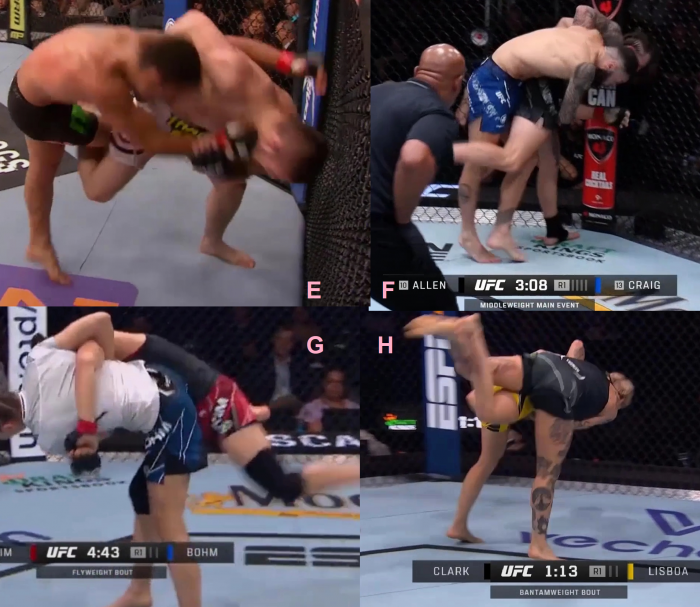
I absolutely love how in-depth you get with techniques. I think I need to clarify the definition of shallow underhook because it changes based on the style you are referring to. In wrestling, if you have your hand on the shoulder blade and you can move / control your opponent then you have yourself an underhook, often called a shallow underhook. In BJJ, an underhook becomes a shallow underhook when your opponent can reach and control your elbow line. Submissions like Ude Garami (MIR Lock / Americana) and Ude Gatame (Straight Arm Lock) really change the game. Looks like Zhumashbek was really clubbing and punching that underhook in during the match, especially in the second half. Besides Liu’s double in the first Zhumashbek really did shut down Liu’s leg attacks and almost got a lift at 2:45. Also, 100% it’s harder to get deep underhooks on higher skilled opponents. Check out Abdulrashid Sadulaev’s Underhook Throw-By highlights: https://youtu.be/GTV8Zivw[...]ure=shared
Thanks for the clarifications and yes, that all makes a lot of sense. I love underhook throw-by, it's probably the move i hit most in wrestling since i'm usually the oldest guy on the mat and don't really want to get into a battle of who can level change the fastest. I'm always hunting for an underhook which gives me attacks like the throw-by, but more importantly stops the 20-something year olds level quickly changing on me. In turn, they tend to address the underhook which is why I wanted to try and codify the thought process a bit.
I'm also doing a video on Judo in MMA and nearly all the uchi mata and harai goshi are done with a whizzer, I also noticed in the majority of them, you can see the attackers elbow poking up and wondered if there was anything we could say that implies about the biomechanics. I don't get hit by whizzer kicks / uchi mata / harai goshi / head and arm / koshi guruma very often myself as i'm generally expecting them when i go for the underhook throw-by and set my hips to keep the posture. Clearly they work though...
I'm also doing a video on Judo in MMA and nearly all the uchi mata and harai goshi are done with a whizzer, I also noticed in the majority of them, you can see the attackers elbow poking up and wondered if there was anything we could say that implies about the biomechanics. I don't get hit by whizzer kicks / uchi mata / harai goshi / head and arm / koshi guruma very often myself as i'm generally expecting them when i go for the underhook throw-by and set my hips to keep the posture. Clearly they work though...
RBlack belt 1st degreeVerified
2 year(s) ago
Well, now you guys have me looking into the throw-by.
MGBlack beltVerified
 AK
AKPurple beltVerified
2 year(s) ago
So thanks for all the previous replies, I went over this with a coach today in a lot of detail. I can grasp the importance of motion more now, which won't be a problem in the video but it's not something I can really share here. I also now understand that certain muscles / muscle groups make the throws work (not just the shoulder) and things like elbow position can indicate these being properly engaged, but also not necessarily. Therefore, we are indeed limited in what we can draw from some pictures, although there are some examples where the muscle groups couldn't possibly be engaged properly in the position we see.
Thanks for the useful discussion.
Thanks for the useful discussion.



