
Rules for main forums
- Be nice
- No advertisement
- No events
- No fundraisers
- No topics asking for votes
- Only posts related to Brazilian Jiu Jitsu
Flow Rolling, Cannabis, and Music: A Therapeutic Approach for 40+ Practitioners?
1 year(s) ago • 1476 views • 14 replies
 ME
MEPurple beltVerified

1 year(s) ago
Hello everyone,
I’d like to start a thoughtful discussion and hear opinions from both seasoned practitioners and professionals in BJJ.
I’m in my early 50s, returning to the mats after a long break. As someone focused on mental health, longevity, and the art of movement, I’ve been exploring a concept I’d describe as:
Flow rolling under cannabis microdose, with chill music in a no-pressure setting — for recovery, stress relief, and reconnecting with the body.
The goal is not competition or intensity, but therapeutic movement, emotional reset, and presence. Think of it as a gentle rolling meditation — with partners who respect each other’s limits, without ego, under the influence of relaxing music and a safe, minimal THC environment (where legal).
This idea came from observing how many 40+ practitioners struggle with overtraining, stress, or the pressure of constantly “grinding.” What if we let go of the push — and replaced it with flow?
Questions for the community:
* Have any of you tried rolling under these conditions?
* Do you think cannabis-assisted movement has a place in BJJ practice (for recovery or therapeutic purposes)?
* Could this be a new way to heal and evolve with age — mentally and physically?
I completely respect any legal or ethical concerns around cannabis and am not promoting recreational misuse, but rather a conscious, intentional use to restore the connection between breath, body, and balance — especially for those in the second half of life.
Thanks in advance for your thoughts — I’m genuinely curious about the science, philosophy, and personal experiences around this.
OSS.
I’d like to start a thoughtful discussion and hear opinions from both seasoned practitioners and professionals in BJJ.
I’m in my early 50s, returning to the mats after a long break. As someone focused on mental health, longevity, and the art of movement, I’ve been exploring a concept I’d describe as:
Flow rolling under cannabis microdose, with chill music in a no-pressure setting — for recovery, stress relief, and reconnecting with the body.
The goal is not competition or intensity, but therapeutic movement, emotional reset, and presence. Think of it as a gentle rolling meditation — with partners who respect each other’s limits, without ego, under the influence of relaxing music and a safe, minimal THC environment (where legal).
This idea came from observing how many 40+ practitioners struggle with overtraining, stress, or the pressure of constantly “grinding.” What if we let go of the push — and replaced it with flow?
Questions for the community:
* Have any of you tried rolling under these conditions?
* Do you think cannabis-assisted movement has a place in BJJ practice (for recovery or therapeutic purposes)?
* Could this be a new way to heal and evolve with age — mentally and physically?
I completely respect any legal or ethical concerns around cannabis and am not promoting recreational misuse, but rather a conscious, intentional use to restore the connection between breath, body, and balance — especially for those in the second half of life.
Thanks in advance for your thoughts — I’m genuinely curious about the science, philosophy, and personal experiences around this.
OSS.
 FB
FBBlack belt 3rd degreeVerified
1 year(s) ago
As much as I enjoy flow rolling I am sorry to say that I am against substances and drugs. So this part of the idea would not fit with me. I rather try to control my ego and relax willingly without the use. Or the help.
 JC
JCPurple beltVerified
1 year(s) ago
I'm not a fan of mixing drugs with training. Different people respond differently to drugs; what causes one person to simply mellow out may cause another to go temporarily brain dead. I've rolled with people that have been smoking weed and you never know what you're going to get. You tell one person you've got an injury you're trying to take care of and they are cool with it and understand, the next person you tell doesn't hear a word you said. Admittedly, the same thing happens with people who aren't high, but that's been a far less frequent experience for me.
 M
MBlack beltVerified
1 year(s) ago
Hello everyone, I’d like to start a thoughtful discussion and hear opinions from both seasoned practitioners and professionals in BJJ. I’m in my early 50s, returning to the mats after a long break. As someone focused on mental health, longevity, and the art of movement, I’ve been exploring a concept I’d describe as: Flow rolling under cannabis microdose, with chill music in a no-pressure setting — for recovery, stress relief, and reconnecting with the body. The goal is not competition or intensity, but therapeutic movement, emotional reset, and presence. Think of it as a gentle rolling meditation — with partners who respect each other’s limits, without ego, under the influence of relaxing music and a safe, minimal THC environment (where legal). This idea came from observing how many 40+ practitioners struggle with overtraining, stress, or the pressure of constantly “grinding.” What if we let go of the push — and replaced it with flow? Questions for the community: * Have any of you tried rolling under these conditions? * Do you think cannabis-assisted movement has a place in BJJ practice (for recovery or therapeutic purposes)? * Could this be a new way to heal and evolve with age — mentally and physically? I completely respect any legal or ethical concerns around cannabis and am not promoting recreational misuse, but rather a conscious, intentional use to restore the connection between breath, body, and balance — especially for those in the second half of life. Thanks in advance for your thoughts — I’m genuinely curious about the science, philosophy, and personal experiences around this. OSS.
I agree with the others who have already commented. Regarding your idea, similar concepts have been explored using psychedelics like MDMA, psilocybin, and ketamine, particularly for individuals with treatment-resistant conditions who don’t find meaningful relief from standard therapies.
Before incorporating any substance, I would suggest trying exactly what you’re describing—without the drug first. See if you can train your body and mind to reach that relaxed state independently, potentially reducing the need for any external substances. I strongly believe in teaching the mind to manage stressors naturally, rather than relying on outside influences.
Before incorporating any substance, I would suggest trying exactly what you’re describing—without the drug first. See if you can train your body and mind to reach that relaxed state independently, potentially reducing the need for any external substances. I strongly believe in teaching the mind to manage stressors naturally, rather than relying on outside influences.
MEPurple beltVerified
1 year(s) ago
As much as I enjoy flow rolling I am sorry to say that I am against substances and drugs. So this part of the idea would not fit with me. I rather try to control my ego and relax willingly without the use. Or the help.
Thanks for your response — I totally respect your perspective. Personally, I don’t use any substances and prefer to work on relaxation and ego through breath and awareness.
That said, I’ve seen that in some countries, this kind of cannabis-assisted practice is used therapeutically — not recreationally, but to support people dealing with anxiety, trauma, or emotional stress.
I’m genuinely curious how it works in those settings, and whether anyone here has had experience with that. Maybe it could exist as a separate space for those who truly need it. Of course, it’s not for everyone — and that’s exactly why the community’s perspective matters. Respect and OSS.
That said, I’ve seen that in some countries, this kind of cannabis-assisted practice is used therapeutically — not recreationally, but to support people dealing with anxiety, trauma, or emotional stress.
I’m genuinely curious how it works in those settings, and whether anyone here has had experience with that. Maybe it could exist as a separate space for those who truly need it. Of course, it’s not for everyone — and that’s exactly why the community’s perspective matters. Respect and OSS.
MEPurple beltVerified
1 year(s) ago
I'm not a fan of mixing drugs with training. Different people respond differently to drugs; what causes one person to simply mellow out may cause another to go temporarily brain dead. I've rolled with people that have been smoking weed and you never know what you're going to get. You tell one person you've got an injury you're trying to take care of and they are cool with it and understand, the next person you tell doesn't hear a word you said. Admittedly, the same thing happens with people who aren't high, but that's been a far less frequent experience for me.
That’s a very valid concern, and I really appreciate you sharing your experience. The unpredictability you mentioned — especially in a setting where safety and trust are everything — is something that definitely needs to be considered.
If anything like this were ever to happen, I believe it would have to be in a completely separate, clearly defined context — not a regular open mat, but something structured with full consent, clear communication, and ideally some professional oversight.
Your point reinforces why this kind of discussion is so important — to understand the real risks, not just the potential benefits. OSS.
If anything like this were ever to happen, I believe it would have to be in a completely separate, clearly defined context — not a regular open mat, but something structured with full consent, clear communication, and ideally some professional oversight.
Your point reinforces why this kind of discussion is so important — to understand the real risks, not just the potential benefits. OSS.
MEPurple beltVerified
1 year(s) ago
I agree with the others who have already commented. Regarding your idea, similar concepts have been explored using psychedelics like MDMA, psilocybin, and ketamine, particularly for individuals with treatment-resistant conditions who don’t find meaningful relief from standard therapies. Before incorporating any substance, I would suggest trying exactly what you’re describing—without the drug first. See if you can train your body and mind to reach that relaxed state independently, potentially reducing the need for any external substances. I strongly believe in teaching the mind to manage stressors naturally, rather than relying on outside influences.
Thank you — I really appreciate your thoughtful and constructive perspective. I fully agree that learning to access deep states of relaxation and presence without any substances is not only powerful, but foundational. Personally, I’ve been practicing that approach — breath, music, flow, and mindful movement — and I find it incredibly rewarding.
My curiosity about therapeutic substances like cannabis or even psychedelics (where legal and appropriate) comes more from an interest in how they're used in structured, clinical or integrative settings, especially for people dealing with deeper emotional blocks or trauma.
I don’t think this is a path for everyone — definitely not something to be mixed into regular training — but I wonder whether a separate space, like a therapy-informed movement group, could be helpful for those who haven’t found relief through more traditional methods.
Again, thank you for grounding the conversation in self-regulation and conscious practice. That’s where it all begins. OSS.
My curiosity about therapeutic substances like cannabis or even psychedelics (where legal and appropriate) comes more from an interest in how they're used in structured, clinical or integrative settings, especially for people dealing with deeper emotional blocks or trauma.
I don’t think this is a path for everyone — definitely not something to be mixed into regular training — but I wonder whether a separate space, like a therapy-informed movement group, could be helpful for those who haven’t found relief through more traditional methods.
Again, thank you for grounding the conversation in self-regulation and conscious practice. That’s where it all begins. OSS.
 WM
WMBlack belt 5th degreeVerified
1 year(s) ago
You know, instead of laughing at Tai Chi, at a certain point, when we get older, moving around is a very great privilege.
What are we going to do, go about our day, like Walter Mitty waiting for ninjas to attack us?
Or get to enjoying simple pleasures, like walking our dog, or noticing the birds are quiet, which is not natural where I live.
Stand by, BRB.
What are we going to do, go about our day, like Walter Mitty waiting for ninjas to attack us?
Or get to enjoying simple pleasures, like walking our dog, or noticing the birds are quiet, which is not natural where I live.
Stand by, BRB.
MEPurple beltVerified
1 year(s) ago
You know, instead of laughing at Tai Chi, at a certain point, when we get older, moving around is a very great privilege. What are we going to do, go about our day, like Walter Mitty waiting for ninjas to attack us? Or get to enjoying simple pleasures, like walking our dog, or noticing the birds are quiet, which is not natural where I live. Stand by, BRB.
That’s beautifully said. I think you’ve captured the heart of it — the older we get, the more sacred and meaningful movement becomes. It’s not about combat or proving anything anymore; it’s about presence, connection, and gratitude for the fact that we can still move, breathe, and feel.
Whether it’s Tai Chi, flow rolling, or just walking the dog — it’s all part of the same path of awareness and appreciation. We don’t need to be waiting for battles — real or imagined — when life already gives us plenty to tune into, if we’re paying attention.
Thanks for sharing that — it really resonates.
Whether it’s Tai Chi, flow rolling, or just walking the dog — it’s all part of the same path of awareness and appreciation. We don’t need to be waiting for battles — real or imagined — when life already gives us plenty to tune into, if we’re paying attention.
Thanks for sharing that — it really resonates.
WMBlack belt 5th degreeVerified
1 year(s) ago
Coincidentally, my friend, my student, my teacher, and one of my rocks, had a stroke today, on the mats.
I was not there.
But, I was a tie for first to the hospital.
These days, these moments, more precious than diamonds.
We must make good choices.
We live in a universe designed and guaranteed, to kill us all.
So, for every a choice a consequence,
measured against, we are guaranteed to die.
Achilles, the Greatest of Warriors,
and a King,
Reported, when summoned from the Underworld,
with a little blood, mixed with the right kind of earth, and Fire,
that the lowest slave among the living,
was the Envy, of the greatest of former earthly Kings,
or Warriors.
So, on the other hand,
Smoke 'em if you got 'em.
And, I would not moralize too much,
about that rare treat of a hot dog or dough nut.
I was not there.
But, I was a tie for first to the hospital.
These days, these moments, more precious than diamonds.
We must make good choices.
We live in a universe designed and guaranteed, to kill us all.
So, for every a choice a consequence,
measured against, we are guaranteed to die.
Achilles, the Greatest of Warriors,
and a King,
Reported, when summoned from the Underworld,
with a little blood, mixed with the right kind of earth, and Fire,
that the lowest slave among the living,
was the Envy, of the greatest of former earthly Kings,
or Warriors.
So, on the other hand,
Smoke 'em if you got 'em.
And, I would not moralize too much,
about that rare treat of a hot dog or dough nut.
MEPurple beltVerified
1 year(s) ago
Coincidentally, my friend, my student, my teacher, and one of my rocks, had a stroke today, on the mats. I was not there. But, I was a tie for first to the hospital. These days, these moments, more precious than diamonds. We must make good choices. We live in a universe designed and guaranteed, to kill us all. So, for every a choice a consequence, measured against, we are guaranteed to die. Achilles, the Greatest of Warriors, and a King, Reported, when summoned from the Underworld, with a little blood, mixed with the right kind of earth, and Fire, that the lowest slave among the living, was the Envy, of the greatest of former earthly Kings, or Warriors. So, on the other hand, Smoke 'em if you got 'em. And, I would not moralize too much, about that rare treat of a hot dog or dough nut.
Thank you for sharing this. I’m really sorry to hear about your friend — I hope he's recovering or at least surrounded by love and care.
What you wrote is powerful, and it resonates deeply. Life really is that fragile — brutal and beautiful at once.
Your reminder about choice, consequence, and the shadow of mortality is something I needed today.
Smoke ‘em if you got ‘em… and still, choose wisely. Much respect.
What you wrote is powerful, and it resonates deeply. Life really is that fragile — brutal and beautiful at once.
Your reminder about choice, consequence, and the shadow of mortality is something I needed today.
Smoke ‘em if you got ‘em… and still, choose wisely. Much respect.
 RA
RABlack belt 1st degreeVerified
1 year(s) ago
Sorry for such a late reply to the thread, but this is something I talk about a lot with some of my students and some of my friends who have all hit a certain age. Having to be mindful of my training now that I'm in the 40+ category is something that I try to keep in my mind since I know most of us older folks get a case of the "I'm still 20, I can do that" when training. I can't use cannabis due to the nature of my work and I couldn't use it before due to being in the military. I also really don't want to rely heavily on anti-inflammatory meds because I would like for them to work when I actually need them. I've started focusing on my recovery as much as making sure I get the most out of my training. I stretch, do some yoga poses, theragun, foam roller and will jump in an ice bath to try to lessen a lot of the bumps, bruises and old injuries as much as I can. I have friends that use cannabis to help and swear by it, I think it's great and I wish there was an avenue for me to use it without losing my job. I don't know if I'm on board with smoking up and rolling, but to each there own and I'm not here to judge. I just know that if I attempted it I wouldn't have a great time haha. I think what I'm saying too is that I wish there was more emphasis put on recovery after class so that you aren't learning these hard lessons after years in the art.
 MG
MGBlack beltVerified
1 year(s) ago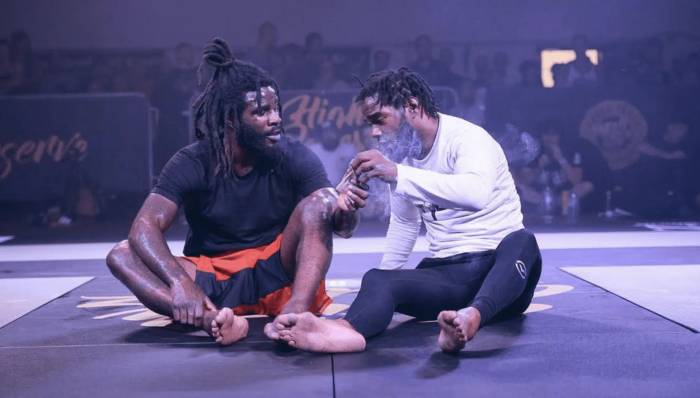
Mr E! I’ll try to answer your questions the best I can. I’ve been grappling for close to 30 years and BJJ for 18 years. Rolling high has been a regular practice of mine for years. Cannabis definitely has a place in BJJ and other sports. It can be both therapeutic and recreational.
I find there is sense of confusion surrounding the subject. All I can do is tell you how it helped me. After being medically released from the military, for a bit there, I hated being touched. How would I return to grappling when a simple leg grab would spin me out?
If you guessed cannabis, you are correct!
I found that cannabis has helped me deal with pain as well as other nervous system related issues. It has also helped me through numerous traumatic injuries. In Jiu Jitsu, mostly I find this quote to be true: “Cannabis can amplify your present-moment awareness, intensifying the connection to your senses and the world around you.” Jiu Jitsu is a form of meditation in motion and is a helpful tool in managing PTSD symptoms.
You don’t need to be a rocket scientist to see how better present-moment awareness can benefit your performance during a round of rolling. Still unsure, take a minute or two to check out the High Rollerz’s website and a few of their YouTube videos. If only for a laugh. So, does cannabis-assisted movement have a place in BJJ practice? Ya, it does. Hopefully, your gym is as understanding as mine was.
Could this be a new way to heal and evolve with age — mentally and physically? Legitimate research is ongoing and promising.
Also, what is a flow roll? Flow is a mental state of complete absorption in an activity, characterized by deep enjoyment, high concentration, and a loss of self-consciousness. Flow is most likely to occur when the challenge of the activity matches the individual's skills. Increasing individual skill takes time so in the short term decrease the challenge. But! You can still “flow” during a competitive roll.
Do cool shit!
I find there is sense of confusion surrounding the subject. All I can do is tell you how it helped me. After being medically released from the military, for a bit there, I hated being touched. How would I return to grappling when a simple leg grab would spin me out?
If you guessed cannabis, you are correct!
I found that cannabis has helped me deal with pain as well as other nervous system related issues. It has also helped me through numerous traumatic injuries. In Jiu Jitsu, mostly I find this quote to be true: “Cannabis can amplify your present-moment awareness, intensifying the connection to your senses and the world around you.” Jiu Jitsu is a form of meditation in motion and is a helpful tool in managing PTSD symptoms.
You don’t need to be a rocket scientist to see how better present-moment awareness can benefit your performance during a round of rolling. Still unsure, take a minute or two to check out the High Rollerz’s website and a few of their YouTube videos. If only for a laugh. So, does cannabis-assisted movement have a place in BJJ practice? Ya, it does. Hopefully, your gym is as understanding as mine was.
Could this be a new way to heal and evolve with age — mentally and physically? Legitimate research is ongoing and promising.
Also, what is a flow roll? Flow is a mental state of complete absorption in an activity, characterized by deep enjoyment, high concentration, and a loss of self-consciousness. Flow is most likely to occur when the challenge of the activity matches the individual's skills. Increasing individual skill takes time so in the short term decrease the challenge. But! You can still “flow” during a competitive roll.
Do cool shit!
MBlack beltVerified
1 year(s) ago
Mr E! I’ll try to answer your questions the best I can. I’ve been grappling for close to 30 years and BJJ for 18 years. Rolling high has been a regular practice of mine for years. Cannabis definitely has a place in BJJ and other sports. It can be both therapeutic and recreational. I find there is sense of confusion surrounding the subject. All I can do is tell you how it helped me. After being medically released from the military, for a bit there, I hated being touched. How would I return to grappling when a simple leg grab would spin me out? If you guessed cannabis, you are correct! I found that cannabis has helped me deal with pain as well as other nervous system related issues. It has also helped me through numerous traumatic injuries. In Jiu Jitsu, mostly I find this quote to be true: “Cannabis can amplify your present-moment awareness, intensifying the connection to your senses and the world around you.” Jiu Jitsu is a form of meditation in motion and is a helpful tool in managing PTSD symptoms. You don’t need to be a rocket scientist to see how better present-moment awareness can benefit your performance during a round of rolling. Still unsure, take a minute or two to check out the High Rollerz’s website and a few of their YouTube videos. If only for a laugh. So, does cannabis-assisted movement have a place in BJJ practice? Ya, it does. Hopefully, your gym is as understanding as mine was. Could this be a new way to heal and evolve with age — mentally and physically? Legitimate research is ongoing and promising. Also, what is a flow roll? Flow is a mental state of complete absorption in an activity, characterized by deep enjoyment, high concentration, and a loss of self-consciousness. Flow is most likely to occur when the challenge of the activity matches the individual's skills. Increasing individual skill takes time so in the short term decrease the challenge. But! You can still “flow” during a competitive roll. Do cool shit!
Appreciate you sharing your story—it’s clear cannabis has played a meaningful role in your recovery and return to the mats, and that’s powerful.
That said, I’ll gently tap the brakes on the “you don’t need to be a rocket scientist” line. It may be meant in jest, but it can come across as dismissive to folks who are still exploring or even questioning cannabis’ role in their training. It’s not about intelligence—it’s about individual neurochemistry and experience. What helps one grappler hit flow might leave another wondering why their gi suddenly feels like it’s made of wet denim or lead weights.
I’ve actually done a fair amount of research into this subject myself—and I know one of the High Rollerz founders personally. I have had some good conversations with him as well about the effects it has for him. I have deep respect for what they’re doing in terms of building community and reshaping perceptions around cannabis and movement.
That said, like with most substances, the individual response is what really matters. For some, cannabis enhances body awareness, creativity, and recovery. For others, it impairs timing or fogs mental clarity. Both experiences are valid. The key is leaving space on the mat for all of it—with or without a pre-roll.
At the end of the day, we’re all just trying to evolve, flow, and do cool shit—whatever path gets us there.
I’m all for open-minded rolling—but if your gi smells like a reggae festival and a skunk had a custody battle, we’re gonna need to talk about boundaries... and laundry!
That said, I’ll gently tap the brakes on the “you don’t need to be a rocket scientist” line. It may be meant in jest, but it can come across as dismissive to folks who are still exploring or even questioning cannabis’ role in their training. It’s not about intelligence—it’s about individual neurochemistry and experience. What helps one grappler hit flow might leave another wondering why their gi suddenly feels like it’s made of wet denim or lead weights.
I’ve actually done a fair amount of research into this subject myself—and I know one of the High Rollerz founders personally. I have had some good conversations with him as well about the effects it has for him. I have deep respect for what they’re doing in terms of building community and reshaping perceptions around cannabis and movement.
That said, like with most substances, the individual response is what really matters. For some, cannabis enhances body awareness, creativity, and recovery. For others, it impairs timing or fogs mental clarity. Both experiences are valid. The key is leaving space on the mat for all of it—with or without a pre-roll.
At the end of the day, we’re all just trying to evolve, flow, and do cool shit—whatever path gets us there.
I’m all for open-minded rolling—but if your gi smells like a reggae festival and a skunk had a custody battle, we’re gonna need to talk about boundaries... and laundry!
MGBlack beltVerified
1 year(s) ago
Appreciate you sharing your story—it’s clear cannabis has played a meaningful role in your recovery and return to the mats, and that’s powerful. That said, I’ll gently tap the brakes on the “you don’t need to be a rocket scientist” line. It may be meant in jest, but it can come across as dismissive to folks who are still exploring or even questioning cannabis’ role in their training. It’s not about intelligence—it’s about individual neurochemistry and experience. What helps one grappler hit flow might leave another wondering why their gi suddenly feels like it’s made of wet denim or lead weights. I’ve actually done a fair amount of research into this subject myself—and I know one of the High Rollerz founders personally. I have had some good conversations with him as well about the effects it has for him. I have deep respect for what they’re doing in terms of building community and reshaping perceptions around cannabis and movement. That said, like with most substances, the individual response is what really matters. For some, cannabis enhances body awareness, creativity, and recovery. For others, it impairs timing or fogs mental clarity. Both experiences are valid. The key is leaving space on the mat for all of it—with or without a pre-roll. At the end of the day, we’re all just trying to evolve, flow, and do cool shit—whatever path gets us there. I’m all for open-minded rolling—but if your gi smells like a reggae festival and a skunk had a custody battle, we’re gonna need to talk about boundaries... and laundry!
Better present-moment awareness is independent of the use of cannabis. So no I wasn’t being dismissive.
What’s worse: stinky gi guy or reggae festival and skunk gi guy?
What’s worse: stinky gi guy or reggae festival and skunk gi guy?



