
Rules for main forums
- Be nice
- No advertisement
- No events
- No fundraisers
- No topics asking for votes
- Only posts related to Brazilian Jiu Jitsu
Flow Rolling: A Guide for Newbies
5 month(s) ago • 426 views • 13 replies
 FR
FRPurple beltVerified

5 month(s) ago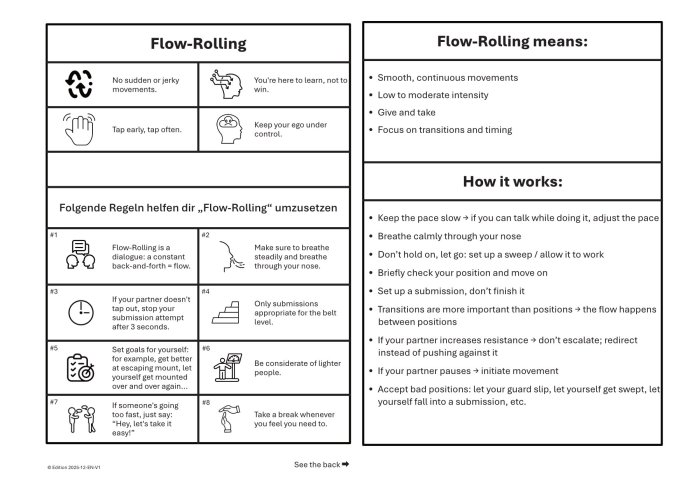
When people first start BJJ, it’s completely normal to go hard, fast, and a bit “spazzy.” Most beginners rely on strength and intensity because they haven’t yet developed timing, control, or awareness. And when two white belts spar together, things can escalate quickly—often beyond what’s helpful or safe.
Unfortunately, this is where injuries can happen. Or just as common: egos take a hit, frustration builds, and some people quietly stop showing up.
That’s exactly why I created this flyer.
Its purpose is simple: to introduce beginners to the concept of flow rolling and give them a clear, practical guideline. Flow rolling helps you move with intention, stay relaxed, and learn faster—without the pressure of “winning” every exchange. It encourages awareness, control, and mutual respect, which are essential for long-term progress in BJJ.
This flyer (currently a double-sided A5 format flyer, but adaptable to any size. Happy to share if someone is interested...) is meant to support that mindset early on and create a healthier training environment for everyone.
I’d really love to hear your thoughts and feedback—thank you!
Unfortunately, this is where injuries can happen. Or just as common: egos take a hit, frustration builds, and some people quietly stop showing up.
That’s exactly why I created this flyer.
Its purpose is simple: to introduce beginners to the concept of flow rolling and give them a clear, practical guideline. Flow rolling helps you move with intention, stay relaxed, and learn faster—without the pressure of “winning” every exchange. It encourages awareness, control, and mutual respect, which are essential for long-term progress in BJJ.
This flyer (currently a double-sided A5 format flyer, but adaptable to any size. Happy to share if someone is interested...) is meant to support that mindset early on and create a healthier training environment for everyone.
I’d really love to hear your thoughts and feedback—thank you!
 J
JBlack belt 3rd degreeVerified
5 month(s) ago
Great idea! Perhaps even too many points, or could be in combination with a poster summarizing it in just a few points. Basically "Keep it playful and generous! Helax and feel the rhytm! Catch and release submissions."
A couple of quick reflections and thoughts:
Sudden but soft and controlled movements are no problem in flow rolling, playing a bit with tempo changes. If you both keep on flowing with it, "fast" isn't really an issue and not an opposite of "easy". You can go fast but still relaxed. But you need to have the flow together if you're to increasing the speed, so it's really mutual and well matched.
"Folgende Regeln..." is obviously not in Enlish as of now.
Letting yourself be e.g. mounted over and over can disrupt the flow. And is that giving to your opponent, who should be generous as well? Is lacking flow really what you need to practice from bottom mount, rather than situational sparring with a lot of aliveness and frequent resets?
Why not play with "non-appropriate submissions" for the belt level as well, as long as you don't force them and just are getting yourself and your partner a feel of where they could fit in to the overall flow?
Trying submissions for three seconds ("If your partner doesn't tap") sounds excessive. Catch and release! Or rather catch and let your partner get a feel for where the escape routes are, even if it takes more than a couple of seconds (and give some more openings for escaping/transitioning if the partner doesn't find a quite immediate escape).
A couple of quick reflections and thoughts:
Sudden but soft and controlled movements are no problem in flow rolling, playing a bit with tempo changes. If you both keep on flowing with it, "fast" isn't really an issue and not an opposite of "easy". You can go fast but still relaxed. But you need to have the flow together if you're to increasing the speed, so it's really mutual and well matched.
"Folgende Regeln..." is obviously not in Enlish as of now.
Letting yourself be e.g. mounted over and over can disrupt the flow. And is that giving to your opponent, who should be generous as well? Is lacking flow really what you need to practice from bottom mount, rather than situational sparring with a lot of aliveness and frequent resets?
Why not play with "non-appropriate submissions" for the belt level as well, as long as you don't force them and just are getting yourself and your partner a feel of where they could fit in to the overall flow?
Trying submissions for three seconds ("If your partner doesn't tap") sounds excessive. Catch and release! Or rather catch and let your partner get a feel for where the escape routes are, even if it takes more than a couple of seconds (and give some more openings for escaping/transitioning if the partner doesn't find a quite immediate escape).
FRPurple beltVerified
5 month(s) ago
Very good and valuable points Johan, thank you very much! I will modify it (and yes, some words are not very well ... as translated from German). kind regards, Flavio
FRPurple beltVerified
5 month(s) ago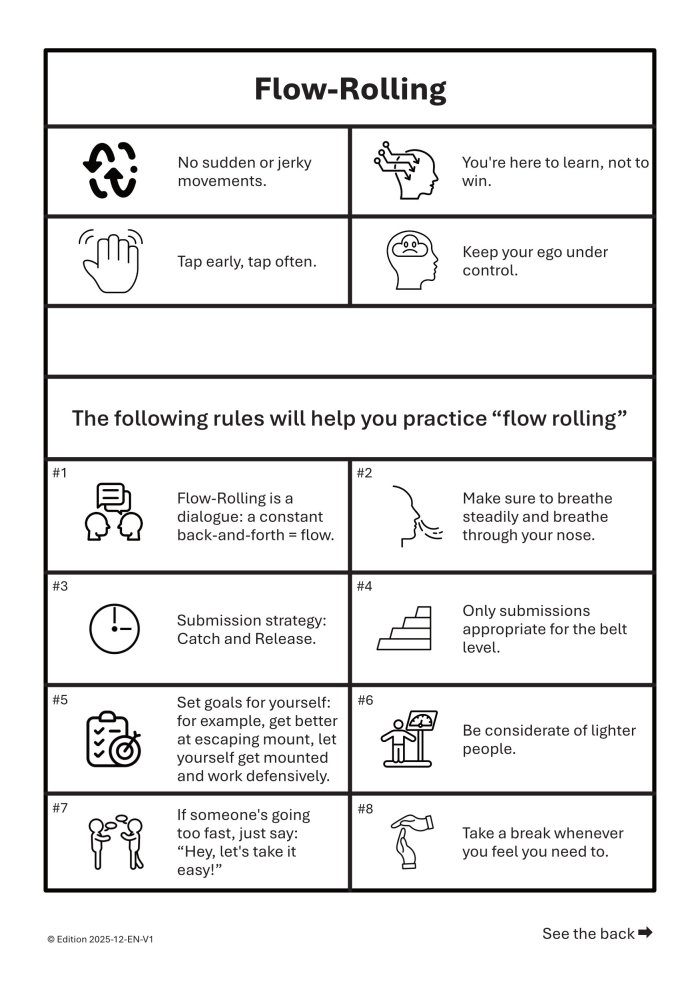
Updated file with modifications...
> concerning "non-appropriate submissions": the experience was that upper-belts hit wrist-locks to whitebelts and these lead to injuries very quickly. Whitebelts dont see the danger and act unpredictably. So it will constrain the upper-belts, and the whitebelts are "just" dealing submissions they know already ... and less injuries (these rules are really just for the Newbies...)
thank you!
> concerning "non-appropriate submissions": the experience was that upper-belts hit wrist-locks to whitebelts and these lead to injuries very quickly. Whitebelts dont see the danger and act unpredictably. So it will constrain the upper-belts, and the whitebelts are "just" dealing submissions they know already ... and less injuries (these rules are really just for the Newbies...)
thank you!
 CG
CGBlack belt 4th degreeVerified
 R
RBlack belt 3rd degreeVerified
5 month(s) ago
In our academy, flow rolling is a fundamental part of our system. We don’t encourage hard, ego-driven sparring. Before every session, we remind our students to roll as light as possible, to move continuously, and to stay aware.
Tap early. Don’t wait for the last second, you might get hurt.
This philosophy has been with us since we opened the academy in 2016, and over time we’ve clearly seen the difference it makes. Not in comparison to others, this isn’t about that, but in the results within our own team.
We have very few injuries, and when they happen, they are usually minor accidents—not serious ones. That’s the direct outcome of how we train.
At the core, it’s about health. We are not a competition-driven team. If what we do is not sustainable, then it’s not worth doing.
At first, many students don’t fully understand this approach. But with time, they feel it, and they recognize its value.
Train intelligently.
Respect your partner.
They are not your opponent, they are part of your progress.
If you follow that mindset, you’re on the right path. I think :)
Tap early. Don’t wait for the last second, you might get hurt.
This philosophy has been with us since we opened the academy in 2016, and over time we’ve clearly seen the difference it makes. Not in comparison to others, this isn’t about that, but in the results within our own team.
We have very few injuries, and when they happen, they are usually minor accidents—not serious ones. That’s the direct outcome of how we train.
At the core, it’s about health. We are not a competition-driven team. If what we do is not sustainable, then it’s not worth doing.
At first, many students don’t fully understand this approach. But with time, they feel it, and they recognize its value.
Train intelligently.
Respect your partner.
They are not your opponent, they are part of your progress.
If you follow that mindset, you’re on the right path. I think :)
 D
DBrown beltVerified
5 month(s) ago
Why not both? Seriously? Or do you? I’m not discounting flow at all. I also encourage it, ESPECIALLY white belts.
Do you have issues with retention for those that want to use bjj for health and cardio benefits?
Do you have issues with retention for those that want to use bjj for health and cardio benefits?
 JC
JCPurple beltVerified
5 month(s) ago
No flow rolling. Every match is to the death! At least it seems that way most nights. Gravity is a cold hearted thankless bitch from which there is no escape and that makes flowing pretty difficult for lots of us more rotund grapplers whose more athletic days have passed. Sometimes the closest you can get to flow rolling is to just lay there and let your training partner climb on the jungle gym.
RBlack belt 3rd degreeVerified
5 month(s) ago
Good question Ken, and the answer isn’t black or white.
Why flow rolling? Why not go hard every time?
It depends on who you are, where you train, and what you want to become.
If your goal is to be a top competitor as fast as possible, then yes, you’ll have to accept risk. Hard rounds, injuries, pushing limits… that’s part of the path. If it’s your profession, you’re essentially trading your body for performance and results.
But if jiu-jitsu is there to improve your life, your health, your mind, then it’s a completely different equation.
Flow rolling doesn’t mean being soft or sloppy. It means controlled intensity. You can go at a high pace, stay sharp, technical, even competitive, but without trying to break each other.
You’re managing the roll instead of letting ego or chaos take over.
No unnecessary damage
No reckless submissions
No “win at all cost” mindset
The idea is simple: reduce risk, increase longevity.
Because in this game, everything is about risk management. The less unnecessary risk you take, the longer you can train, improve, and stay consistent.
At the end of the day, if you’re a working guy, with responsibilities, maybe long days, a family… it’s just not worth it to destroy your body for a few minutes of ego battle. One bad round can mean months off, surgery, and everything else on pause.
Flow rolling is what allows you to train tomorrow, next week, next year, and that’s where real progress happens.
Why flow rolling? Why not go hard every time?
It depends on who you are, where you train, and what you want to become.
If your goal is to be a top competitor as fast as possible, then yes, you’ll have to accept risk. Hard rounds, injuries, pushing limits… that’s part of the path. If it’s your profession, you’re essentially trading your body for performance and results.
But if jiu-jitsu is there to improve your life, your health, your mind, then it’s a completely different equation.
Flow rolling doesn’t mean being soft or sloppy. It means controlled intensity. You can go at a high pace, stay sharp, technical, even competitive, but without trying to break each other.
You’re managing the roll instead of letting ego or chaos take over.
No unnecessary damage
No reckless submissions
No “win at all cost” mindset
The idea is simple: reduce risk, increase longevity.
Because in this game, everything is about risk management. The less unnecessary risk you take, the longer you can train, improve, and stay consistent.
At the end of the day, if you’re a working guy, with responsibilities, maybe long days, a family… it’s just not worth it to destroy your body for a few minutes of ego battle. One bad round can mean months off, surgery, and everything else on pause.
Flow rolling is what allows you to train tomorrow, next week, next year, and that’s where real progress happens.
RBlack belt 3rd degreeVerified
5 month(s) ago
No flow rolling. Every match is to the death! At least it seems that way most nights. Gravity is a cold hearted thankless bitch from which there is no escape and that makes flowing pretty difficult for lots of us more rotund grapplers whose more athletic days have passed. Sometimes the closest you can get to flow rolling is to just lay there and let your training partner climb on the jungle gym.
Flow becomes more valuable, especially if you’re not a high-level competitor, because you start to see the reality of the game. It’s not really about beating gravity… it’s about accepting that you can’t stop it, so you learn to move with it.
Same logic everywhere:
If someone is stronger, you don’t meet strength with strength
If someone is faster or more explosive, you don’t chase that game
And even the opposite:
If someone is smaller or more agile, don’t just try to out-trick them blindly
You don’t fight attributes, you adapt to them.
You go with what’s happening, you play along just enough, and then you find the intelligent path inside it. That’s where flow really lives. Not in being soft, but in being aligned with reality instead of resisting it.
Because the moment you stop trying to impose your game at all costs… you start seeing openings that weren’t there before.
Same logic everywhere:
If someone is stronger, you don’t meet strength with strength
If someone is faster or more explosive, you don’t chase that game
And even the opposite:
If someone is smaller or more agile, don’t just try to out-trick them blindly
You don’t fight attributes, you adapt to them.
You go with what’s happening, you play along just enough, and then you find the intelligent path inside it. That’s where flow really lives. Not in being soft, but in being aligned with reality instead of resisting it.
Because the moment you stop trying to impose your game at all costs… you start seeing openings that weren’t there before.
DBrown beltVerified
5 month(s) ago
Good question Ken, and the answer isn’t black or white. Why flow rolling? Why not go hard every time? It depends on who you are, where you train, and what you want to become. If your goal is to be a top competitor as fast as possible, then yes, you’ll have to accept risk. Hard rounds, injuries, pushing limits… that’s part of the path. If it’s your profession, you’re essentially trading your body for performance and results. But if jiu-jitsu is there to improve your life, your health, your mind, then it’s a completely different equation. Flow rolling doesn’t mean being soft or sloppy. It means controlled intensity. You can go at a high pace, stay sharp, technical, even competitive, but without trying to break each other. You’re managing the roll instead of letting ego or chaos take over. No unnecessary damage No reckless submissions No “win at all cost” mindset The idea is simple: reduce risk, increase longevity. Because in this game, everything is about risk management. The less unnecessary risk you take, the longer you can train, improve, and stay consistent. At the end of the day, if you’re a working guy, with responsibilities, maybe long days, a family… it’s just not worth it to destroy your body for a few minutes of ego battle. One bad round can mean months off, surgery, and everything else on pause. Flow rolling is what allows you to train tomorrow, next week, next year, and that’s where real progress happens.
Good points, Robert and I appreciate the feedback back. Our gym has a very eclectic mash of students all with different personalities and goals. We have a retired 70 year old paratrooper who rolls for health, an 18 year old preparing for MMA and everything in between including a quite large woman’s group. So we need an eclectic curriculum.
I personally flow roll my first round, grab 2 or 3 white belts to work defense chaining and then work my way up to my professor which often is a death match 😂 I’m the highest rank besides him so it’s a great opportunity to push each other.
To each their own. My goal in the next 3 years is to open another Jean Jacques affiliate academy so I’m sure my gym will differ from any other.
I personally flow roll my first round, grab 2 or 3 white belts to work defense chaining and then work my way up to my professor which often is a death match 😂 I’m the highest rank besides him so it’s a great opportunity to push each other.
To each their own. My goal in the next 3 years is to open another Jean Jacques affiliate academy so I’m sure my gym will differ from any other.
FRPurple beltVerified
5 month(s) ago
Good points, Robert and I appreciate the feedback back. Our gym has a very eclectic mash of students all with different personalities and goals. We have a retired 70 year old paratrooper who rolls for health, an 18 year old preparing for MMA and everything in between including a quite large woman’s group. So we need an eclectic curriculum. I personally flow roll my first round, grab 2 or 3 white belts to work defense chaining and then work my way up to my professor which often is a death match 😂 I’m the highest rank besides him so it’s a great opportunity to push each other. To each their own. My goal in the next 3 years is to open another Jean Jacques affiliate academy so I’m sure my gym will differ from any other.
Nice comments and inputs!
I realized that intense sparring can quickly lead to injuries—and often discourages newcomers to join the sport.
Another important realization I made so far is, that high-level competitors, tend to roll relatively lightly most of the time—rolling with a smooth flow. Sparring only gets “tougher” some weeks before the competition...
I realized that intense sparring can quickly lead to injuries—and often discourages newcomers to join the sport.
Another important realization I made so far is, that high-level competitors, tend to roll relatively lightly most of the time—rolling with a smooth flow. Sparring only gets “tougher” some weeks before the competition...
 YP
YPBlack beltVerified
3 month(s) ago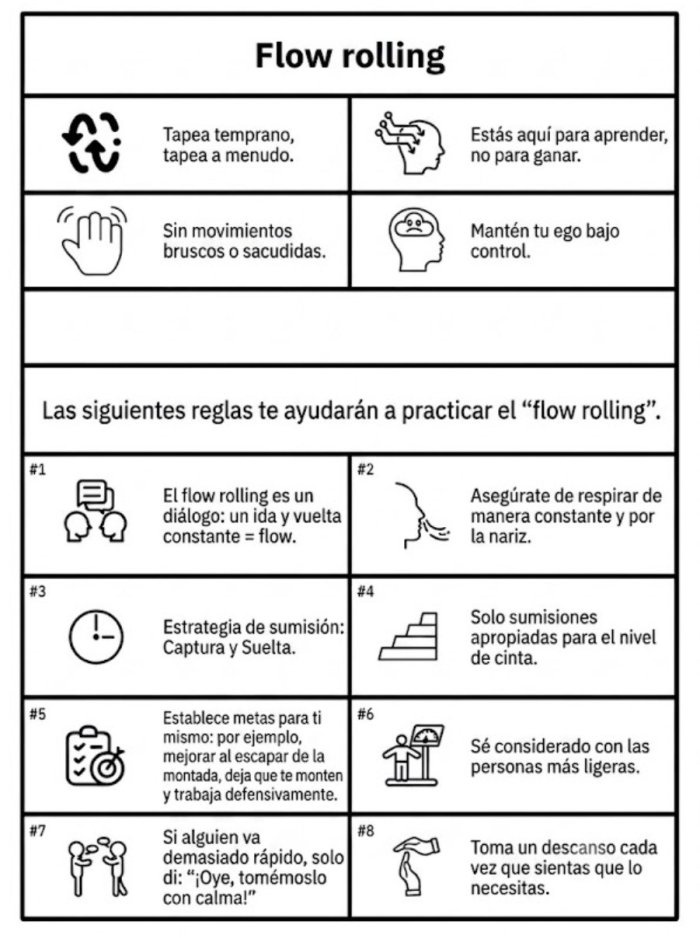
Hi, thank you so much for sharing this info, it is very helpful since I also share this mindset. In case you find it useful, I believe this is verybuseful information for the bjj comunity thta should be shared, therefore I have done the mexican spanish version, here in mexico we have several words that we use directly and we don't translate, like "tap out" we say "tapear" and "to roll" we say "vamos a rolar", and "belt" we don't say "cinturón" (spain spanish) we say "cinta"
FRPurple beltVerified
3 month(s) ago
so cool, thank you Yuriana!



