
Rules for main forums
- Be nice
- No advertisement
- No events
- No fundraisers
- No topics asking for votes
- Only posts related to Brazilian Jiu Jitsu
Ryan Hall's interview
6 year(s) ago • 916 views • 14 replies
 AK
AKPurple beltVerified
6 year(s) ago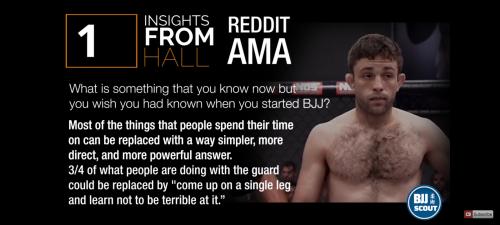
He said: 3/4 of what people are doing with the guard could be replaced by 'come up on a single leg'
Could anyone help unpack that statement, I can't really visualise what he is talking about?
Could anyone help unpack that statement, I can't really visualise what he is talking about?
 DC
DCBlack belt 3rd degreeVerified

6 year(s) ago
He said: 3/4 of what people are doing with the guard could be replaced by 'come up on a single leg' Could anyone help unpack that statement, I can't really visualise what he is talking about?
You don't "wrestle up"?
I will often change up to a single (or ankle pick) when my opponent stands in my guard, or when I choose to move from de la riva/ single leg X to a standing position.
I will often change up to a single (or ankle pick) when my opponent stands in my guard, or when I choose to move from de la riva/ single leg X to a standing position.
 C
CBlack belt 1st degreeVerified
6 year(s) ago
Yeah why play with a sloppy DLR/RDLR/worm/whatnot if you could just pressure forward with a (low) single? I think it's mostly about people failing to recognise a chance for that forward pressure. I used to have that problem and I noticed a huge difference once I started to go for the singles. They don't always work out that great, but at least you get a chance for a better guard!
 HL
HLPurple beltVerified
6 year(s) ago
Getting up or pulling guard - playing guard might be a tactical desicion. My background is in karate so standing up is natural for me. (I also would not like to be sitting if it was a selfdefence situation. I run faster compared to butt scooting.)
But in competition scene it can be an effective tactic to play guard.
Stephen Whittier teaches that if opponent does not give pressure when you are playing guard, stand up using a technical standup or attack a single leg. So he is on the same page with Ryan Hall - one of many...
But in competition scene it can be an effective tactic to play guard.
Stephen Whittier teaches that if opponent does not give pressure when you are playing guard, stand up using a technical standup or attack a single leg. So he is on the same page with Ryan Hall - one of many...
 TP
TPBlack beltVerified
6 year(s) ago
I think his first sentence applies more to BJJ in general, and the example of coming up to a single may be more in relation to grappling in MMA, which he obviously currently does, where getting on the feet carries even more weight.
That said, half guard and many open guards offer pretty simple options to bump the guy forward and come up with the leg.
That said, half guard and many open guards offer pretty simple options to bump the guy forward and come up with the leg.
AKPurple beltVerified
6 year(s) ago
Ok thanks guys, so he's saying that a lot of BJJ is inefficient because people are looking to play guard, rather than achieve something better? If that's his point then I agree in wider context of fighting where guard is a bad position. But in BJJ it's statistically good, especially in the Gi.
 JM
JMBlack belt 2nd degreeVerified
6 year(s) ago
When you look at modern BJJ then coming up to singles (and taking the back off of it) has become really prominent - lot of it in last ADCC and recent Mundials/Euros.
TPBlack beltVerified
6 year(s) ago
so he's saying that a lot of BJJ is inefficient because people are looking to play guard, rather than achieve something better?
Yeah, I read it that way: most of "playing" guard is ineffective, and one should use it to more directly to get on top/submit. But playing complex guard games is fun, as that is "the seductive nature of guard", as worded by Chris Haueter.
(I've only seen the short quote you posted, not the whole interview.)
(I've only seen the short quote you posted, not the whole interview.)
 RD
RDBlack belt 4th degreeVerified
6 year(s) ago
But playing complex guard games is fun, as that is "the seductive nature of guard", as worded by Chris Haueter.
Getting to top from the bottom position is a huge part of how I play and teach guard but I also agree with Chris Haueter's statement. It sure is fun.
 WM
WMBlack belt 5th degreeVerified
6 year(s) ago
I agree with Ryan Hall.
 SZ
SZBlack belt 1st degreeVerified
6 year(s) ago
Getting to top from the bottom position is a huge part of how I play and teach guard but I also agree with Chris Haueter's statement. It sure is fun.
Yes it is!
DCBlack belt 3rd degreeVerified
6 year(s) ago
Hauter also says that everyone masturbates, you just don't brag about it (in regards to guard pullers).
AKPurple beltVerified
6 year(s) ago
Yeah, I read it that way: most of 'playing' guard is ineffective, and one should use it to more directly to get on top/submit. But playing complex guard games is fun, as that is 'the seductive nature of guard', as worded by Chris Haueter. (I've only seen the short quote you posted, not the whole interview.)
It's not that i disagree but submissions in BJJ are less than 50% of matches and most of them come from the back or by attacking the legs from the bottom, depending on the rules set (i.e. not on top). I'm talking statistics here, not personal experience, but submissions from side control and mount are a small percentage of high level BJJ wins. In MMA, the opposite is true, where winning from mount, side control and even top guard is common.
I do follow his logic, especially in MMA, perhaps NoGi. But statistically i think he's wrong in Gi. Pulling and playing guard is by far the best strategy in the Gi, in terms of risk vrs reward. You don't risk a takedown, you're much more likely to sweep them than have you guard passed and you might even take their back.
Please correct my logic if i've said anything untrue. This is me trying to generalise based on statistics and what i observe. I'm not saying these are iron laws of nature.
I do follow his logic, especially in MMA, perhaps NoGi. But statistically i think he's wrong in Gi. Pulling and playing guard is by far the best strategy in the Gi, in terms of risk vrs reward. You don't risk a takedown, you're much more likely to sweep them than have you guard passed and you might even take their back.
Please correct my logic if i've said anything untrue. This is me trying to generalise based on statistics and what i observe. I'm not saying these are iron laws of nature.
 CB
CBBlack belt 2nd degreeVerified
6 year(s) ago
It's not that i disagree but submissions in BJJ are less than 50% of matches and most of them come from the back or by attacking the legs from the bottom, depending on the rules set (i.e. not on top). I'm talking statistics here, not personal experience, but submissions from side control and mount are a small percentage of high level BJJ wins. In MMA, the opposite is true, where winning from mount, side control and even top guard is common. I do follow his logic, especially in MMA, perhaps NoGi. But statistically i think he's wrong in Gi. Pulling and playing guard is by far the best strategy in the Gi, in terms of risk vrs reward. You don't risk a takedown, you're much more likely to sweep them than have you guard passed and you might even take their back. Please correct my logic if i've said anything untrue. This is me trying to generalise based on statistics and what i observe. I'm not saying these are iron laws of nature.
I think your logic applies to a particular skillset and weight class; if you have trash takedowns, you aren't as likely to end up in top position in any way, for instance. Pulling guard is also a terrible strategy if you aren't one of the smaller fellows -- for example, I'm an ultra heavy, and in my division the guy on the bottom is the guy losing more often than not.
If you have trash takedowns, poor passing and a Great guard....well then, your best choice is to play guard. I think your analysis points to particular problems in the BJJ culture, and less to what's actually effective and what's not given equal skill-building and time investment.
If you have trash takedowns, poor passing and a Great guard....well then, your best choice is to play guard. I think your analysis points to particular problems in the BJJ culture, and less to what's actually effective and what's not given equal skill-building and time investment.
AKPurple beltVerified
6 year(s) ago
I think your logic applies to a particular skillset and weight class; if you have trash takedowns, you aren't as likely to end up in top position in any way, for instance. Pulling guard is also a terrible strategy if you aren't one of the smaller fellows -- for example, I'm an ultra heavy, and in my division the guy on the bottom is the guy losing more often than not. If you have trash takedowns, poor passing and a Great guard....well then, your best choice is to play guard. I think your analysis points to particular problems in the BJJ culture, and less to what's actually effective and what's not given equal skill-building and time investment.
Excellent points, well made



