
Rules for main forums
- Be nice
- No advertisement
- No events
- No fundraisers
- No topics asking for votes
- Only posts related to Brazilian Jiu Jitsu
sisterpage judochecker.com dead?
3 year(s) ago • 1322 views • 40 replies
 CB
CBBrown beltVerified
3 year(s) ago
All of us can trace our lineage back to Kano. It's pretty much the same thing.
Problem I have with that is where does the tracing things back stop. Are Judo, Sambo and BJJ all the same as Kito and Tenjin Shinyo Ryu because Judo came from them?
 SE
SEBlack belt 1st degreeVerified

3 year(s) ago
To make a long story short: no, if it is older.
Every grappling-style coming after Kano invented Judo is minimum compatible to Judo or a even a derivative. That is the idea of a final container. Holistic in every way.🤓
But this kind of philosophy only works with a maximum of flexibility and tolerance.
Both is the opposite of todays IJF -„Judo“.
Every grappling-style coming after Kano invented Judo is minimum compatible to Judo or a even a derivative. That is the idea of a final container. Holistic in every way.🤓
But this kind of philosophy only works with a maximum of flexibility and tolerance.
Both is the opposite of todays IJF -„Judo“.
 R
RBlack beltVerified
3 year(s) ago
I'm sorry, you lost me here. So, if I'm reading your post correctly, you agree that Kano was trying to make something distinct and separate from the koryu jujutsu before him.
This falls short as a description of kano's intentions.
Initially, he trained in three koryu. In two of them, namely in Tenshin Shin'yo Ryu and Kito Ryu, he was awarded the highest rank "Menkyo Kaiden" (= unlimited teaching license).
His own dojo, the Kodokan, opened in 1882, was considered the dojo of the Kito Ryu school until at least 1885.
(There are citable sources for this.)
However, Kano's intentions and views have changed over the years.
Just as an example, in 1935 Kano began to involve weapon techniques in judo.
The division "Kodokan Bojutsu" was officially founded.
Kano wrote (1935): "That is about eight years ago (Showa 2, 1927), we gathered people interested in the Kodokan and we started practicing in bojutsu Tamai Sensei, Sensei Shiina, Ito Sensei and Sensei of Katori Shinto Ryu, Kuboki, all from the prefecture of Chiba. About four years ago we received, from Fukuoka, Shimizu Sensei of Shindo Muso Ryu (jojutsu), and still continue the practice of this technique."
Unfortunately, the idea of establishing a "modernized" bojutsu as part of judo died with Kano's death in 1938.
This is just a very brief explanation of what judo used to be and everything that went with it.
:-)
Initially, he trained in three koryu. In two of them, namely in Tenshin Shin'yo Ryu and Kito Ryu, he was awarded the highest rank "Menkyo Kaiden" (= unlimited teaching license).
His own dojo, the Kodokan, opened in 1882, was considered the dojo of the Kito Ryu school until at least 1885.
(There are citable sources for this.)
However, Kano's intentions and views have changed over the years.
Just as an example, in 1935 Kano began to involve weapon techniques in judo.
The division "Kodokan Bojutsu" was officially founded.
Kano wrote (1935): "That is about eight years ago (Showa 2, 1927), we gathered people interested in the Kodokan and we started practicing in bojutsu Tamai Sensei, Sensei Shiina, Ito Sensei and Sensei of Katori Shinto Ryu, Kuboki, all from the prefecture of Chiba. About four years ago we received, from Fukuoka, Shimizu Sensei of Shindo Muso Ryu (jojutsu), and still continue the practice of this technique."
Unfortunately, the idea of establishing a "modernized" bojutsu as part of judo died with Kano's death in 1938.
This is just a very brief explanation of what judo used to be and everything that went with it.
:-)
Edited 3 year(s) ago
SEBlack belt 1st degreeVerified
RBlack beltVerified
3 year(s) ago
Problem I have with that is where does the tracing things back stop. Are Judo, Sambo and BJJ all the same as Kito and Tenjin Shinyo Ryu because Judo came from them?
Sambo (Samozashchita Bez Oruzhiya) means "self-defense without weapons". The founder of sambo was a Russian intelligence officer named Oschepkov.
The term Sambo was coined by a man named V.A. Spiridonov at the beginning of World War I. He understood it to be a type of close-quarters military combat for soldiers in the Russian army. Spiridonov can therefore be considered a pioneer of sambo.
Credit for making sambo a very serious, complex martial art, however, goes to another man. The actual founder of Sambo is demonstrably Vasily Sergeyevich Oschepkov.
Oschepkov was born in December 1892 in Alexandrovski on the island of Sakhalin. (The island of Sakhalin fell to Japan after Russia lost the war against Japan in 1905).
There he attended the school of the Russian Orthodox Church, where he also had the opportunity to train Kodokan Judo. He devoted himself to this training with great zeal and became so successful that as a young man he was chosen to participate in the training of the Kodokan in Tokyo.
The Kodokan archives record that on October 29, 1911, Oschepkov directly participated in Kodokan training for the first time.
It may seem surprising today, but he was taught judo almost as thoroughly as his Japanese peers - an absolute exception for the nationalistic era of the time.
It must be borne in mind that the general understanding of Japanese judo teachers in those days was that it was impossible for a foreigner to understand judo and train as hard as Japanese.
The training at that time was still very much influenced by the rivalry between the schools of jujutsu. Although the Kodokan had won all previous challenge fights against other schools (except against the fighters of the Fusen Ryu), the judoka still had to face the traditional Shin Ken Shobu (ruleless fights, which sometimes went to the death of an opponent), the challenges of others provide schools of jujutsu.
We read about this at Kano Jigoro:
"It seemed that the Kodôkan had to compete against all of Japan and that we had to have a prepared mind."
(Kano Jigoro in: Sakko, Issue No. 6, 1927)
In those years, the Kodokan awarded the Yudansha ranks very sparingly, even to Japanese, as the archives of the Kodokan show.
How much more difficult it must have been for Oschepkov to convince the Japanese teachers of his abilities!
Nevertheless, in 1914 he received the Shodan (1st Dan) in Kodokan Judo, it is said to have been from the hands of Kano Jigoro himself (the latter I believe to be a legend).
Oschepkov was the first Russian to earn this degree. In 1917 he even passed the Nidan (2nd Dan) exam in the Kodokan.
After the end of World War I, Oschepkov left Japan and returned to Russia. Return. In 1921 he became an officer in the Red Army, a few years later he joined the Cheka (secret service) and was deployed in Japan and especially in China.
In 1926 Oschepkov went back to Russia, to Vladivostok, to train young military personnel in judo.
From there he was transferred to Novosibirsk, where he worked at the Red Army's Siberian Military Headquarters as a specialist in East Asian languages. There he also taught his interpretation of functional, realistic self-defense. He did this so successfully that the Red Army General Staff took notice of him.
In 1927, Brigadier General Boris Sergeyevich Kalpus commissioned Oschepkov to develop a functional hand-to-hand combat system for Red Army soldiers.
Oschepkov adopted the term Sambo coined by Spiridonov.
From 1932 Oschepkov headed the Institute for Physical Education in Moscow. His main students there were Kuzovlev, Sidorov, Galkovskii, Skolnikov, Vasiliev and, of course, A. Charalampiev. The latter taught in Leningrad and Moscow and was soon to play an inglorious role.
In 1937 the first great wave of terror rolled over the Soviet Union. Stalin, feeling surrounded by enemies, ordered radical "purges." Hundreds of thousands fell victim to this senseless terror.
V. S. Oschepkov also fell into the sights of the NKVD (= Soviet secret service). He was suspect because he had been abroad in the 1920s - in Japan, in China...
He was arrested and asked to confess to plotting against socialism and against comrade Stalin.
He should confess to being an agent of the Japanese imperialists.
On the night of October 1-2, 1937, he was arrested by the NKVD and died ten days later under circumstances that are still unclear.
Angina pectoris was given as the official cause of death.
The Oschepkov name has now been removed from all sambo-related publications and pronouncements. Photographs were retouched in order to make Oschepkov's face unrecognizable or to make it disappear entirely.
At that time, Sambo was completely unknown outside of the Soviet Union, so this history falsification was easily possible - and it was successful.
Oschepkov's student, Charalampiev, was said to be the founder of sambo. It doesn't exactly show character that Charalampiev got involved and in the following years worked hard on his own myth.
The Japanese roots of sambo were erased with the name Oschepkov and quickly fell into oblivion.
So much for sambo.
Well, I really hope I haven't bored anyone too much with my post...
The term Sambo was coined by a man named V.A. Spiridonov at the beginning of World War I. He understood it to be a type of close-quarters military combat for soldiers in the Russian army. Spiridonov can therefore be considered a pioneer of sambo.
Credit for making sambo a very serious, complex martial art, however, goes to another man. The actual founder of Sambo is demonstrably Vasily Sergeyevich Oschepkov.
Oschepkov was born in December 1892 in Alexandrovski on the island of Sakhalin. (The island of Sakhalin fell to Japan after Russia lost the war against Japan in 1905).
There he attended the school of the Russian Orthodox Church, where he also had the opportunity to train Kodokan Judo. He devoted himself to this training with great zeal and became so successful that as a young man he was chosen to participate in the training of the Kodokan in Tokyo.
The Kodokan archives record that on October 29, 1911, Oschepkov directly participated in Kodokan training for the first time.
It may seem surprising today, but he was taught judo almost as thoroughly as his Japanese peers - an absolute exception for the nationalistic era of the time.
It must be borne in mind that the general understanding of Japanese judo teachers in those days was that it was impossible for a foreigner to understand judo and train as hard as Japanese.
The training at that time was still very much influenced by the rivalry between the schools of jujutsu. Although the Kodokan had won all previous challenge fights against other schools (except against the fighters of the Fusen Ryu), the judoka still had to face the traditional Shin Ken Shobu (ruleless fights, which sometimes went to the death of an opponent), the challenges of others provide schools of jujutsu.
We read about this at Kano Jigoro:
"It seemed that the Kodôkan had to compete against all of Japan and that we had to have a prepared mind."
(Kano Jigoro in: Sakko, Issue No. 6, 1927)
In those years, the Kodokan awarded the Yudansha ranks very sparingly, even to Japanese, as the archives of the Kodokan show.
How much more difficult it must have been for Oschepkov to convince the Japanese teachers of his abilities!
Nevertheless, in 1914 he received the Shodan (1st Dan) in Kodokan Judo, it is said to have been from the hands of Kano Jigoro himself (the latter I believe to be a legend).
Oschepkov was the first Russian to earn this degree. In 1917 he even passed the Nidan (2nd Dan) exam in the Kodokan.
After the end of World War I, Oschepkov left Japan and returned to Russia. Return. In 1921 he became an officer in the Red Army, a few years later he joined the Cheka (secret service) and was deployed in Japan and especially in China.
In 1926 Oschepkov went back to Russia, to Vladivostok, to train young military personnel in judo.
From there he was transferred to Novosibirsk, where he worked at the Red Army's Siberian Military Headquarters as a specialist in East Asian languages. There he also taught his interpretation of functional, realistic self-defense. He did this so successfully that the Red Army General Staff took notice of him.
In 1927, Brigadier General Boris Sergeyevich Kalpus commissioned Oschepkov to develop a functional hand-to-hand combat system for Red Army soldiers.
Oschepkov adopted the term Sambo coined by Spiridonov.
From 1932 Oschepkov headed the Institute for Physical Education in Moscow. His main students there were Kuzovlev, Sidorov, Galkovskii, Skolnikov, Vasiliev and, of course, A. Charalampiev. The latter taught in Leningrad and Moscow and was soon to play an inglorious role.
In 1937 the first great wave of terror rolled over the Soviet Union. Stalin, feeling surrounded by enemies, ordered radical "purges." Hundreds of thousands fell victim to this senseless terror.
V. S. Oschepkov also fell into the sights of the NKVD (= Soviet secret service). He was suspect because he had been abroad in the 1920s - in Japan, in China...
He was arrested and asked to confess to plotting against socialism and against comrade Stalin.
He should confess to being an agent of the Japanese imperialists.
On the night of October 1-2, 1937, he was arrested by the NKVD and died ten days later under circumstances that are still unclear.
Angina pectoris was given as the official cause of death.
The Oschepkov name has now been removed from all sambo-related publications and pronouncements. Photographs were retouched in order to make Oschepkov's face unrecognizable or to make it disappear entirely.
At that time, Sambo was completely unknown outside of the Soviet Union, so this history falsification was easily possible - and it was successful.
Oschepkov's student, Charalampiev, was said to be the founder of sambo. It doesn't exactly show character that Charalampiev got involved and in the following years worked hard on his own myth.
The Japanese roots of sambo were erased with the name Oschepkov and quickly fell into oblivion.
So much for sambo.
Well, I really hope I haven't bored anyone too much with my post...
SEBlack belt 1st degreeVerified
3 year(s) ago
No, not at all!
It is never an overload.
Nobody is forced to read here!
It is never an overload.
Nobody is forced to read here!
CBBrown beltVerified
3 year(s) ago
To make a long story short: no, if it is older. Every grappling-style coming after Kano invented Judo is minimum compatible to Judo or a even a derivative. That is the idea of a final container. Holistic in every way.🤓 But this kind of philosophy only works with a maximum of flexibility and tolerance. Both is the opposite of todays IJF -„Judo“.
Are you saying that any grappling style invented after judo was created is "judo" irregardless of any connection? Is Lute Livre then also Judo despite being developed from folkstyle wrestling? I can kind of see where your coming from with using judo as a sort of umbrella term, but using the term judo in this context is a bit problematic as judo is considered the creation of Kano and by calling other styles, especially those that aren't connected with Kano judo is attributing credit to him as well, even if unintentionally. If this is what you want, then why not just say Grappling? It's a better umbrella term and recognizes that no one person invented it.
SEBlack belt 1st degreeVerified
3 year(s) ago
At this point we are close to each other:
Yes, grappling is the better idea as an umbtella term!
No, it is not o.k. to call every grappling „Judo“ cause that is a robbery in many cases.
Some other cases are discussable (like Sambo, a lot of todays „modern“ JJ-styles and maybe BJJ).
But I -as a Judo guy with that wide understanding of holistic Judo- try to implement EVERY kind of fighting in my Judo. That is the reason I call it my Judo.☝🏻
And that is the reason I wrote, that BJJ made my Judo better every day and it is still ongoing.😉
To come back to Your points made at the beginning of this discussion:
Own BJJ culture ? Yes!
Other results of training specifically BJJ? Yes!
And that leads to another point which I didn‘t want to negotiate (but maybe was not made clear by myself):
INo doubt, that BJJ has an own identity today!
The big question for me is, how much of my understanding of Judo is in there.
-And, maybe, more of original Judo survived in BJJ than in todays so called and known Judo.
Yes, grappling is the better idea as an umbtella term!
No, it is not o.k. to call every grappling „Judo“ cause that is a robbery in many cases.
Some other cases are discussable (like Sambo, a lot of todays „modern“ JJ-styles and maybe BJJ).
But I -as a Judo guy with that wide understanding of holistic Judo- try to implement EVERY kind of fighting in my Judo. That is the reason I call it my Judo.☝🏻
And that is the reason I wrote, that BJJ made my Judo better every day and it is still ongoing.😉
To come back to Your points made at the beginning of this discussion:
Own BJJ culture ? Yes!
Other results of training specifically BJJ? Yes!
And that leads to another point which I didn‘t want to negotiate (but maybe was not made clear by myself):
INo doubt, that BJJ has an own identity today!
The big question for me is, how much of my understanding of Judo is in there.
-And, maybe, more of original Judo survived in BJJ than in todays so called and known Judo.
 MG
MGPurple beltVerified
 BM
BMBlack belt 1st degreeVerified
3 year(s) ago
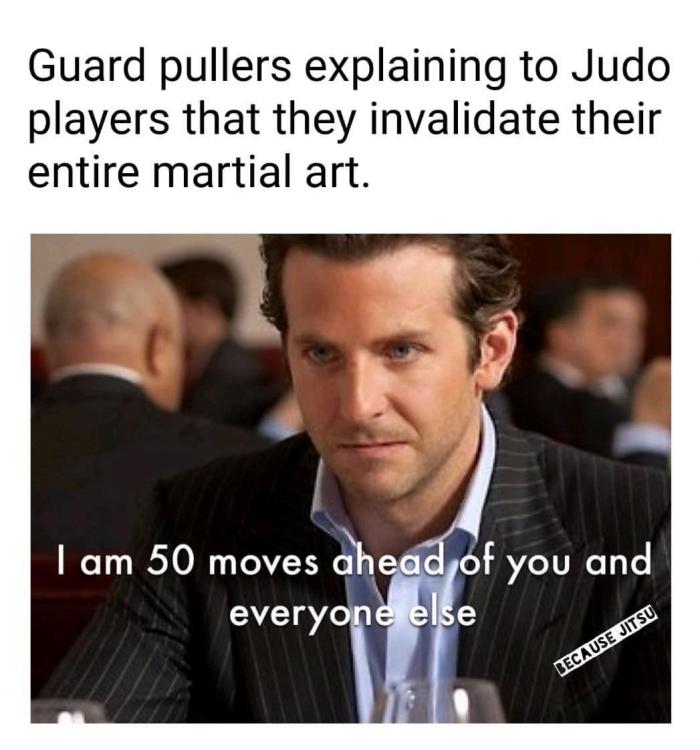
This argument is pointless when you can just pull guard.
I pull guard in judo competition all the time... er... rather... strategically fail at performing tomoe nage. Lol.
SEBlack belt 1st degreeVerified
3 year(s) ago
yoko tomoe nage all the time!
…. and sometimes -accidentally- a nice throw happens.😆
…. and sometimes -accidentally- a nice throw happens.😆



