
Rules for main forums
- Be nice
- No advertisement
- No events
- No fundraisers
- No topics asking for votes
- Only posts related to Brazilian Jiu Jitsu
ROM, or Range of Motion, plays a critical role in Brazilian Jiu-Jitsu
1 year(s) ago • 1452 views • 6 replies
 EV
EVBlack belt 3rd degreeVerified

1 year(s) ago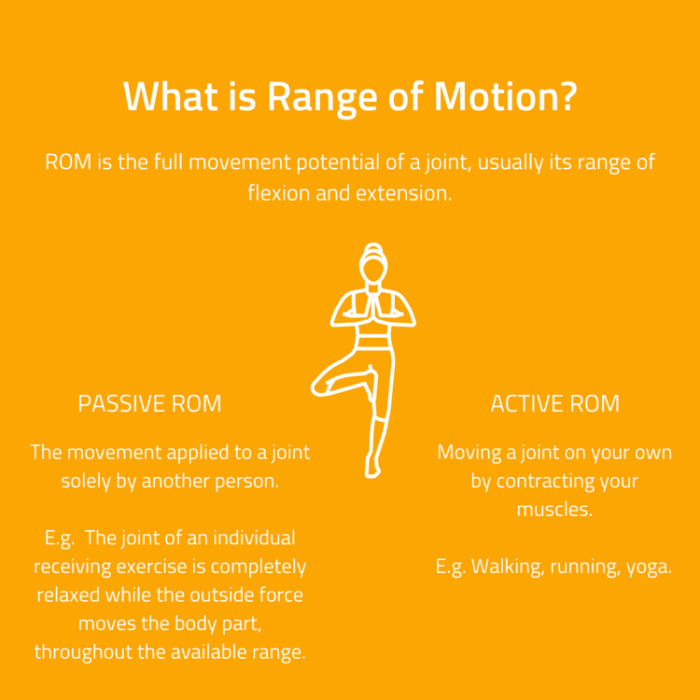
ROM, or Range of Motion, plays a critical role in Brazilian Jiu-Jitsu for several key reasons:
1. Technique Efficiency
BJJ techniques require precision, fluidity, and timing. A well-developed ROM allows you to execute moves like guard passes, sweeps, and submissions smoothly and correctly. Limited mobility can slow you down or cause improper execution, giving your opponent more chances to escape or counter.
2. Injury Prevention
Improving your ROM through mobility drills and stretching helps protect your joints, muscles, and tendons. BJJ often places joints like the shoulders, hips, knees, and ankles in extreme positions. Increased flexibility and mobility make these positions safer and reduce the risk of strains or tears.
3. Better Defensive Options
When you're in bad positions (such as side control, mount, or caught in a submission), good mobility can help you survive and escape. A broader ROM allows your body to adjust and resist more effectively, making it harder for your opponent to finish the submission.
4. Longevity in the Sport
Athletes who prioritize their ROM can train longer and at a higher level. Mobility supports recovery, reduces overuse injuries, and helps preserve healthy movement patterns as you age, keeping you on the mat for years to come.
5. Improved Control and Balance
BJJ isn’t just about strength—it’s about control and leverage. With greater ROM, your body can maintain better balance, transition between positions more fluidly, and respond more effectively to your opponent’s movements.
In summary, ROM is essential in BJJ for optimal technique, injury prevention, defensive capability, athletic longevity, and overall body control. Mobility and flexibility training should be a regular part of every serious BJJ practitioner’s routine.
1. Technique Efficiency
BJJ techniques require precision, fluidity, and timing. A well-developed ROM allows you to execute moves like guard passes, sweeps, and submissions smoothly and correctly. Limited mobility can slow you down or cause improper execution, giving your opponent more chances to escape or counter.
2. Injury Prevention
Improving your ROM through mobility drills and stretching helps protect your joints, muscles, and tendons. BJJ often places joints like the shoulders, hips, knees, and ankles in extreme positions. Increased flexibility and mobility make these positions safer and reduce the risk of strains or tears.
3. Better Defensive Options
When you're in bad positions (such as side control, mount, or caught in a submission), good mobility can help you survive and escape. A broader ROM allows your body to adjust and resist more effectively, making it harder for your opponent to finish the submission.
4. Longevity in the Sport
Athletes who prioritize their ROM can train longer and at a higher level. Mobility supports recovery, reduces overuse injuries, and helps preserve healthy movement patterns as you age, keeping you on the mat for years to come.
5. Improved Control and Balance
BJJ isn’t just about strength—it’s about control and leverage. With greater ROM, your body can maintain better balance, transition between positions more fluidly, and respond more effectively to your opponent’s movements.
In summary, ROM is essential in BJJ for optimal technique, injury prevention, defensive capability, athletic longevity, and overall body control. Mobility and flexibility training should be a regular part of every serious BJJ practitioner’s routine.
 RG
RGBlack belt 1st degreeVerified
1 year(s) ago
Yes to all of this. It’s quite frustrating when i hear upper belts or even black belts say “i cant do that move.” Unless there was a substantial injury, or you’re very old, how can you say you've been training for over a decade…but executing a new move you look as awkward as an injured 3 legged water buffalo. We have no problem pushing our bodies to roll, even when we are sore and jt hurts we push through. Yet we cant take 15 minutes to stretch? I know it’s not the pain of stretching….is it pride? Laziness? Idk… I started doing Yoga on my own at home just to counteract the clock as best as I can.
 JC
JCPurple beltVerified
1 year(s) ago
As someone with limited mobility, I agree. Better ROM makes everything in BJJ easier. But for years I've been told to stretch more, despite doing multiple sessions per day for years. It's not a solution for everyone and it's borderline insulting to have people tell you to do the same thing over and over again when it's not working.
 PG
PGBlue beltVerified
1 year(s) ago
Stretching and mobility are barely related. Stretching is passive motion per the left side of the infographic, because you are generally using unrelated parts of your body to pull on another part. BJJ should be pretty much only active ROM. if you are experiencing passive motion, you should tap.
I know someone who can't touch his toes, but can flip his legs inside out and backwards to execute techniques. I'm a big proponent of doing what you want to get better at, not something else. Yoga or dedicated drilling would be better than simple stretching for BJJ mobility.
I know someone who can't touch his toes, but can flip his legs inside out and backwards to execute techniques. I'm a big proponent of doing what you want to get better at, not something else. Yoga or dedicated drilling would be better than simple stretching for BJJ mobility.
 M
MBlack beltVerified
1 year(s) ago
Stretching and mobility are barely related. Stretching is passive motion per the left side of the infographic, because you are generally using unrelated parts of your body to pull on another part. BJJ should be pretty much only active ROM. if you are experiencing passive motion, you should tap. I know someone who can't touch his toes, but can flip his legs inside out and backwards to execute techniques. I'm a big proponent of doing what you want to get better at, not something else. Yoga or dedicated drilling would be better than simple stretching for BJJ mobility.
Stretching and mobility are more intertwined than they might seem. While stretching is often passive (static holds, assisted motions), mobility encompasses active range of motion (ROM), requiring strength and control in that motion. But dismissing stretching entirely ignores its role in improving mobility over time.
For example, passive static stretching can increase muscle length, reducing tightness that might limit active ROM. A well-stretched muscle moves more freely, making active mobility drills (like deep squats, Cossack lunges, and 90/90 transitions) more effective.
Additionally, some stretches engage strength elements, like Jefferson Curls or deep lunge holds, where flexibility meets stability—essential in guard retention, inversion, and submission defense.
BJJ isn’t solely passive or active; it’s a balance. While tapping to passive force is smart, having a greater ROM (enhanced by stretching and mobility work) allows practitioners to move efficiently, reduce injuries, and adapt better in scrambles.
For example, passive static stretching can increase muscle length, reducing tightness that might limit active ROM. A well-stretched muscle moves more freely, making active mobility drills (like deep squats, Cossack lunges, and 90/90 transitions) more effective.
Additionally, some stretches engage strength elements, like Jefferson Curls or deep lunge holds, where flexibility meets stability—essential in guard retention, inversion, and submission defense.
BJJ isn’t solely passive or active; it’s a balance. While tapping to passive force is smart, having a greater ROM (enhanced by stretching and mobility work) allows practitioners to move efficiently, reduce injuries, and adapt better in scrambles.
PGBlue beltVerified
1 year(s) ago
Maybe the difference is in the definition, because I would still call something like a Jefferson curl or a deep lunge mobility exercises rather than stretches. There's a grey area between the two, but as long as it's not a long static hold without any engagement of the targeted muscles, I would consider it mobility rather than stretch.
I'm almost done with shoulder rehab after my surgery, and the best gains always came from active-assisted movements. I've done only a little bit of true stretching. Even when my PT stretches me passively, she will frequently ask me to engage and disengage the arm in certain ways while she's working on it.
I'm almost done with shoulder rehab after my surgery, and the best gains always came from active-assisted movements. I've done only a little bit of true stretching. Even when my PT stretches me passively, she will frequently ask me to engage and disengage the arm in certain ways while she's working on it.
MBlack beltVerified
1 year(s) ago
Maybe the difference is in the definition, because I would still call something like a Jefferson curl or a deep lunge mobility exercises rather than stretches. There's a grey area between the two, but as long as it's not a long static hold without any engagement of the targeted muscles, I would consider it mobility rather than stretch. I'm almost done with shoulder rehab after my surgery, and the best gains always came from active-assisted movements. I've done only a little bit of true stretching. Even when my PT stretches me passively, she will frequently ask me to engage and disengage the arm in certain ways while she's working on it.
When I was working on my master’s degree in this subject, this analogy really helped me understand the difference between static and active stretching:
Static stretching is like pulling a rubber band and holding it in place—it elongates the muscle without movement. Active stretching, on the other hand, is like pulling the rubber band using another elastic force—it still creates length but engages movement in the process.
Both methods extend the muscle fibers, just in different ways!
Static stretching is like pulling a rubber band and holding it in place—it elongates the muscle without movement. Active stretching, on the other hand, is like pulling the rubber band using another elastic force—it still creates length but engages movement in the process.
Both methods extend the muscle fibers, just in different ways!



