
Beltchecker Health Free
Food for your training Your BJJ nutrition and weight coach
A private food and recovery coach for people who train Jiu Jitsu. Built on long-term health, not quick diets.
Already a member? Log in
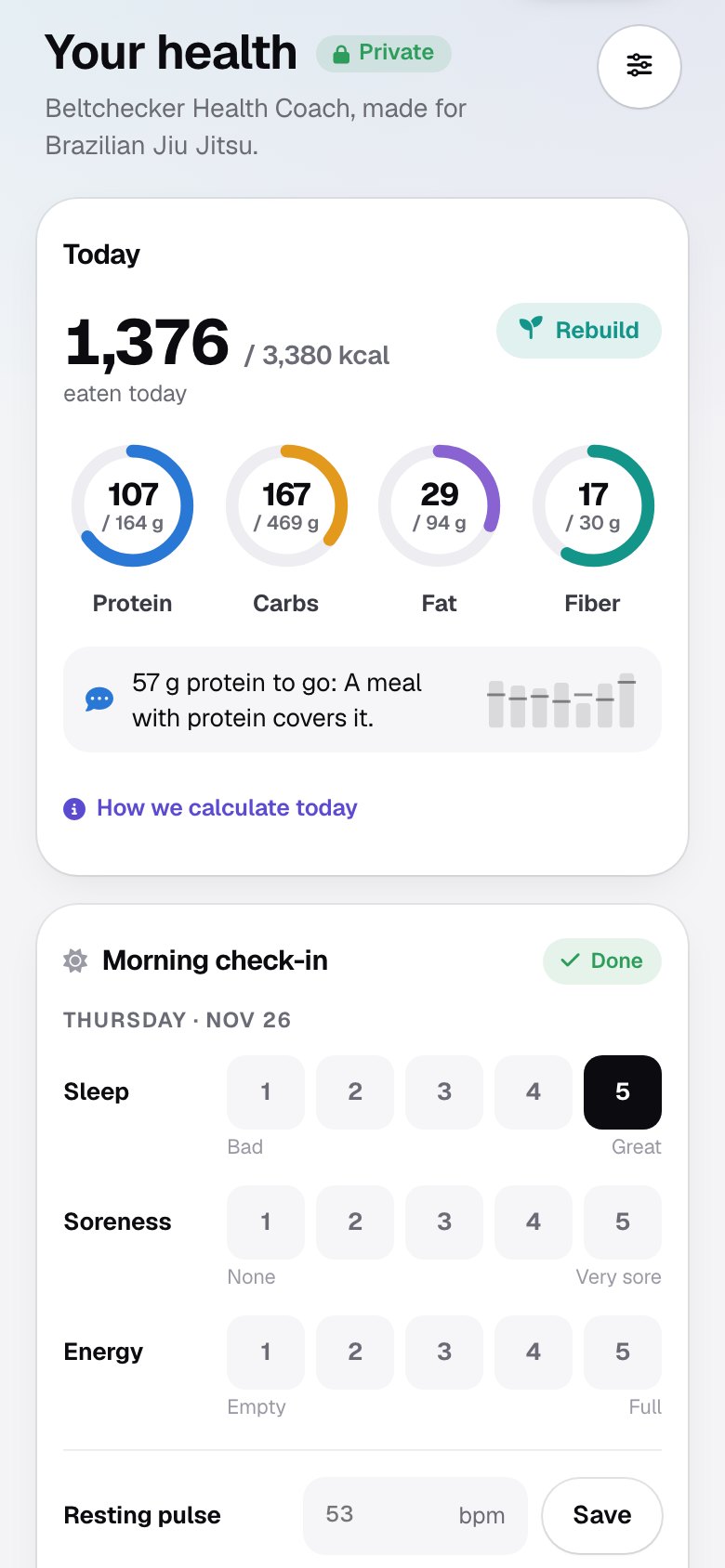
Targets from your training
Your training log sets the day: More food on hard days, less on rest days. Calories, protein, carbs, fat and fiber, and what is left to eat today.
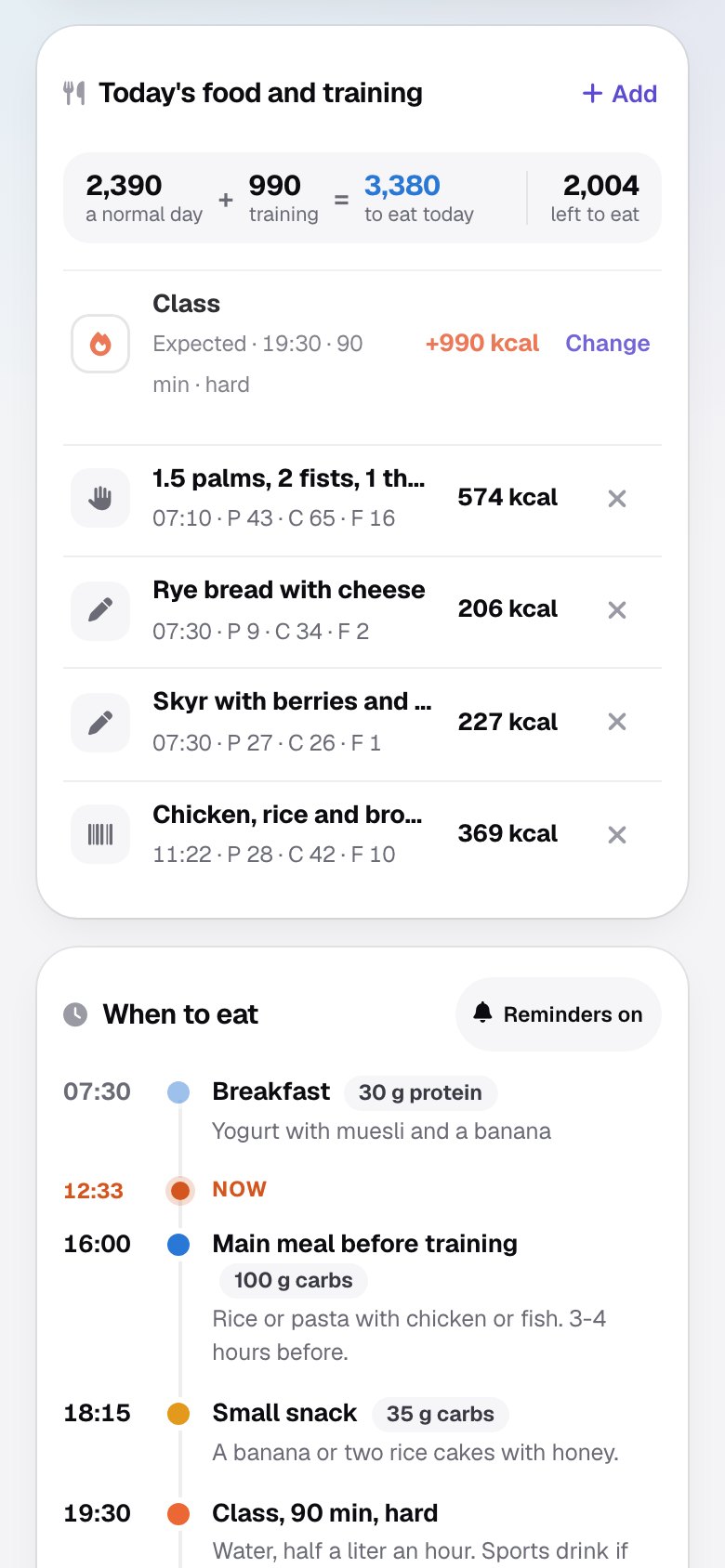
Log a meal in seconds
Write what you ate in plain words, scan a barcode or take a photo. Your training comes straight from your training log.

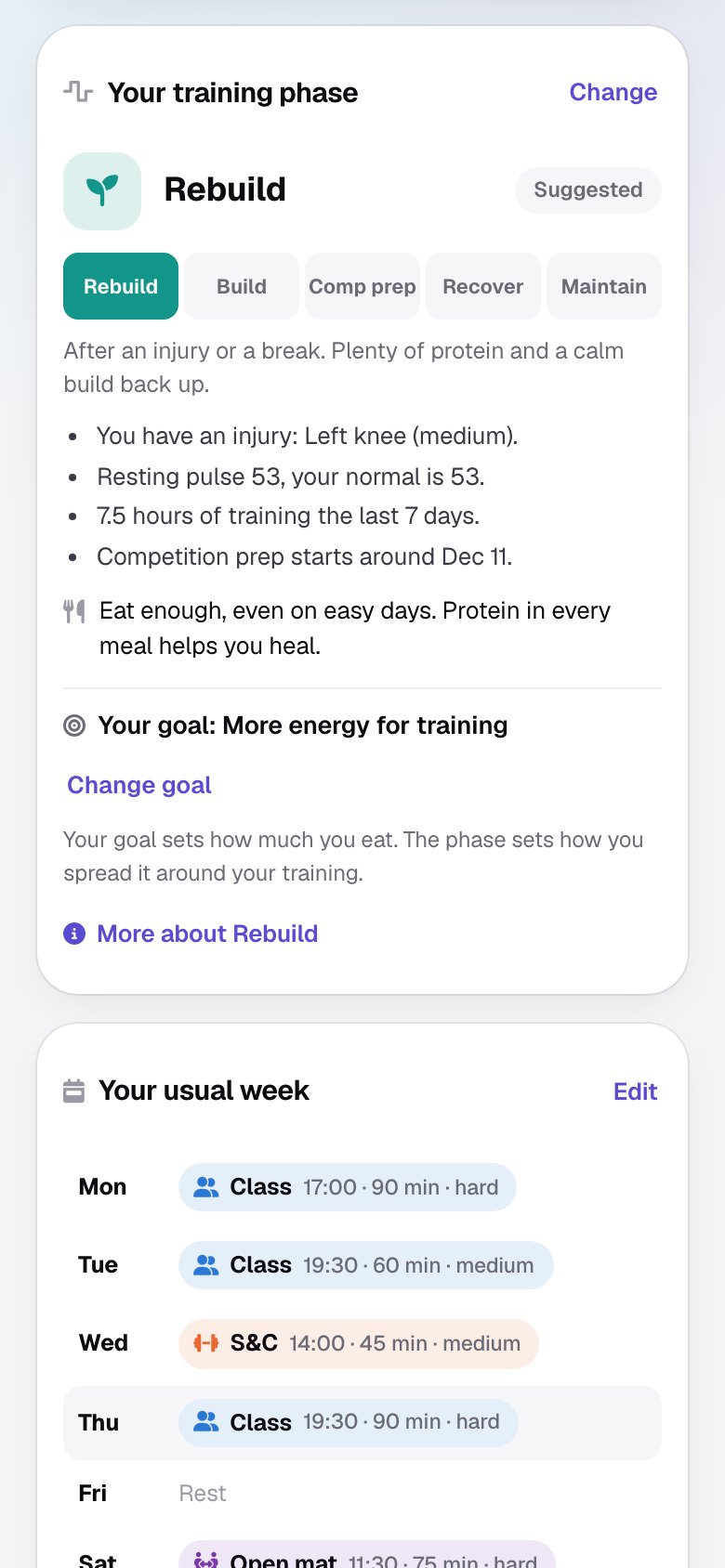
Your training phase
Rebuild after an injury, build, competition prep, recover or maintain. Health suggests the phase from your training, your resting pulse, your injuries and your competitions, and says what it means for your food.
Ready for your competitions
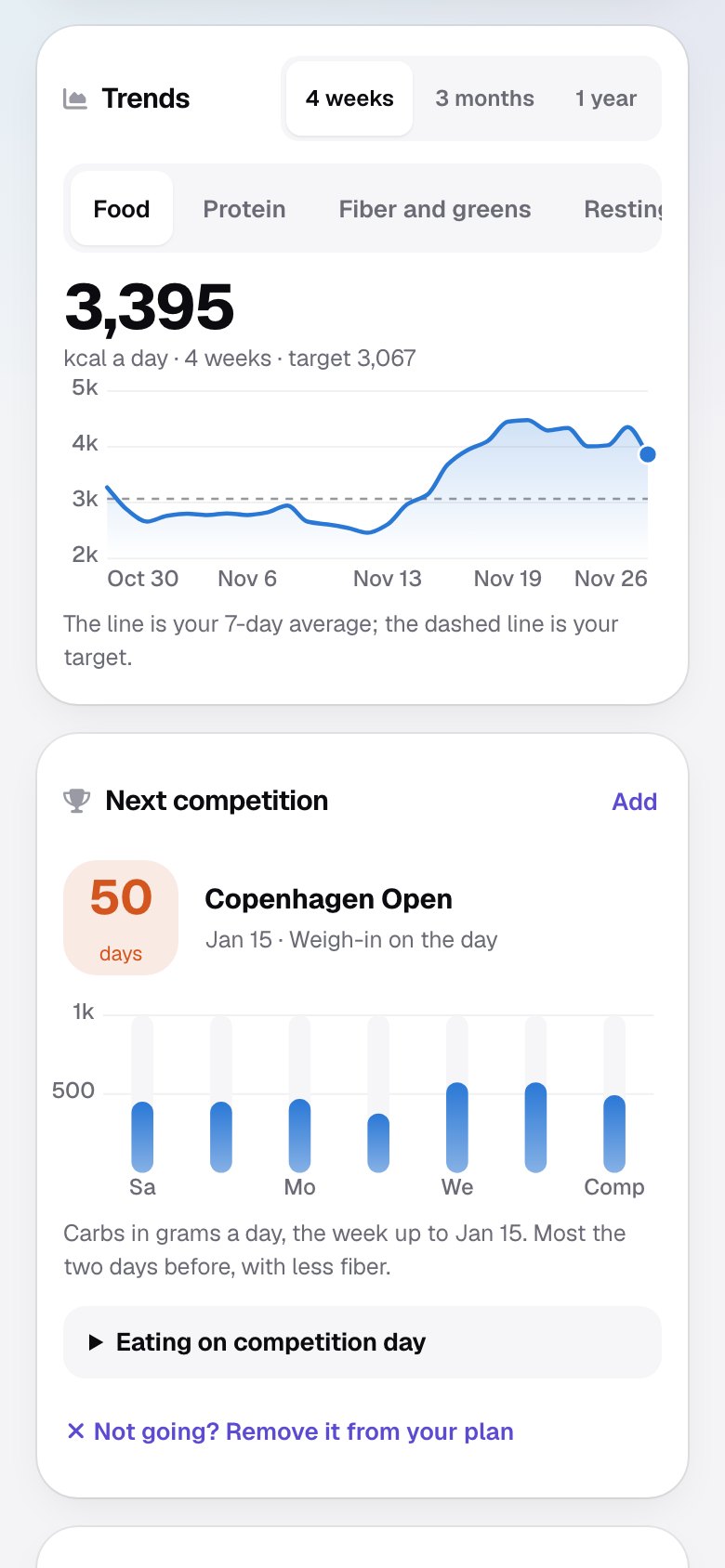
More carbs in the last days, a plan for competition day and a weight class the healthy way: In good time, never by cutting water.
The weeks count, not the day
Trends over 4 weeks, 3 months and a year. A short note from the coach keeps it calm: One day over or under is noise.
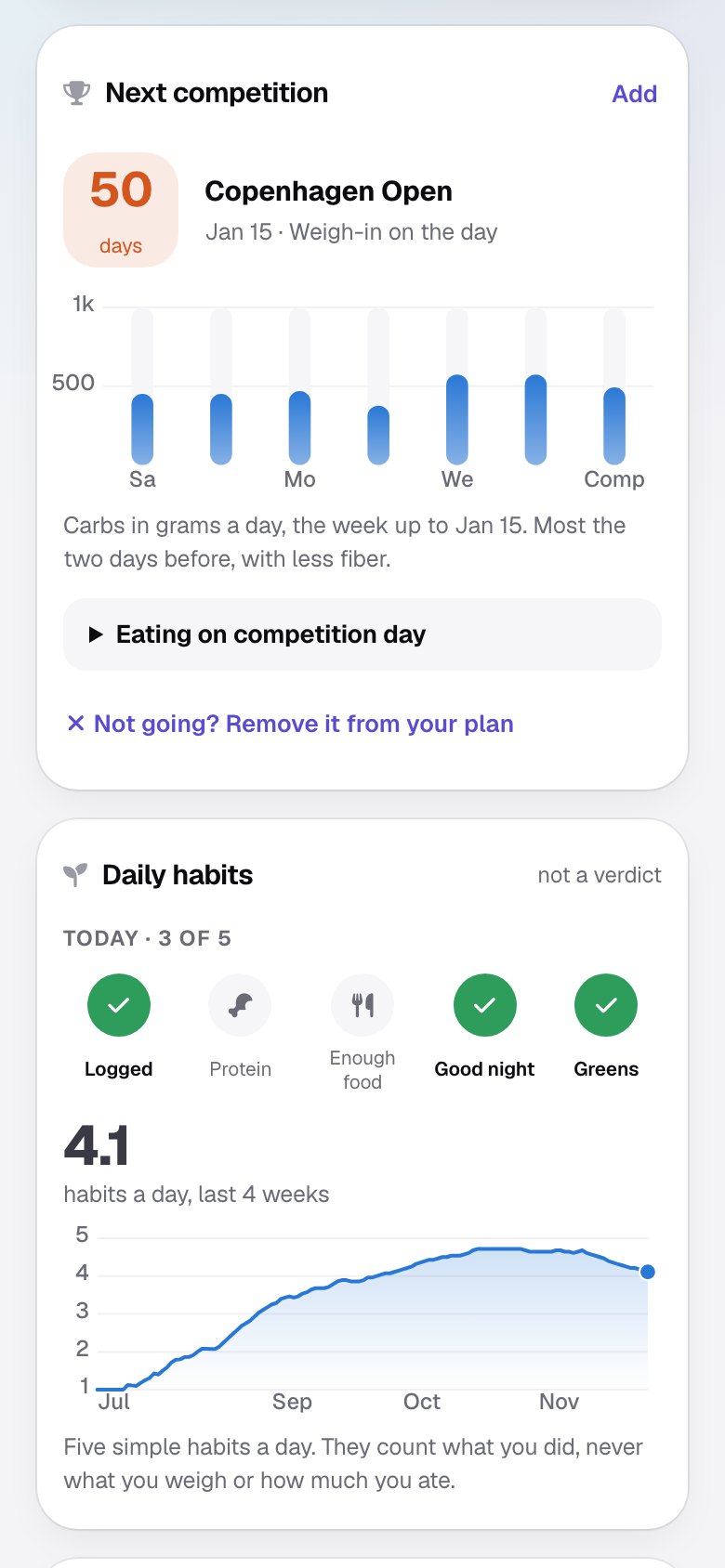
Small habits
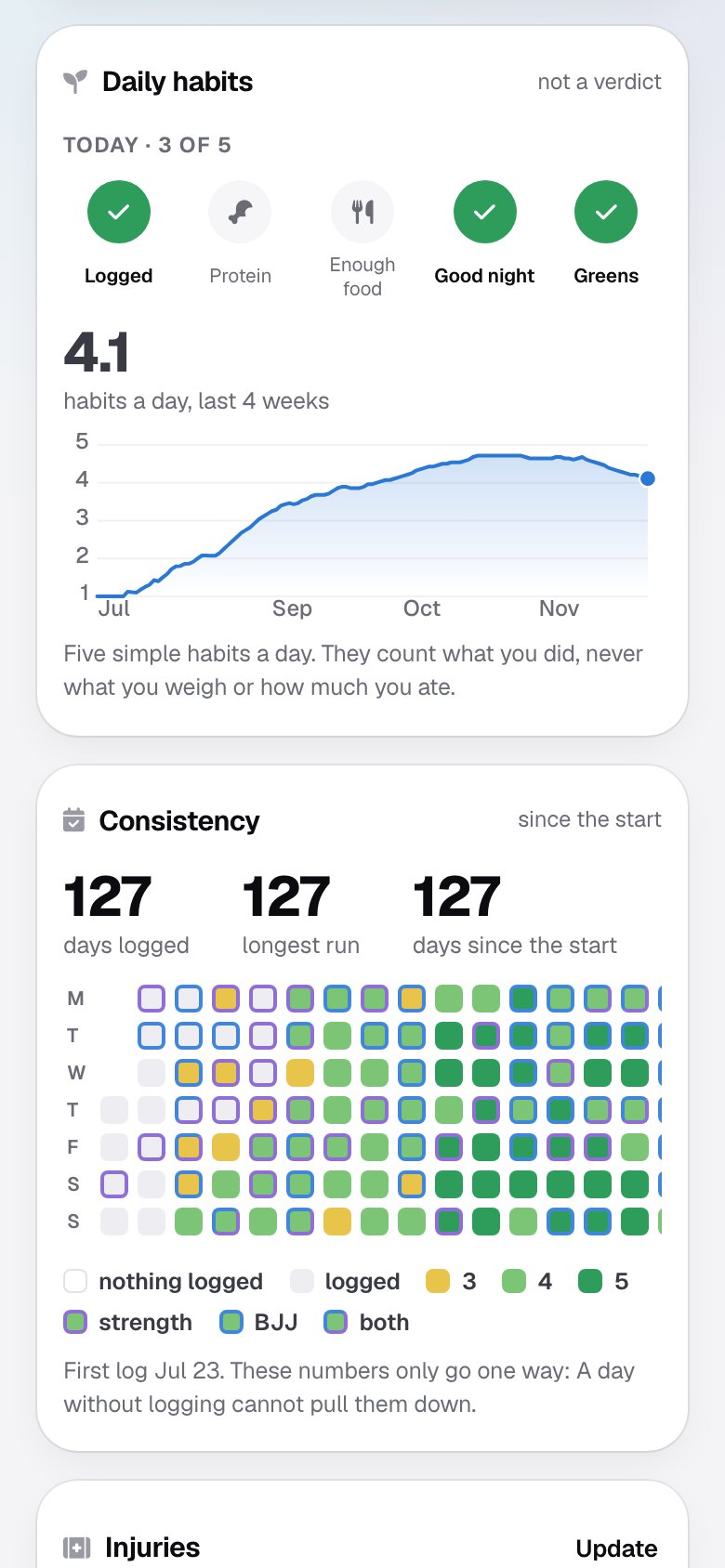
Five simple habits a day: Logged, protein, enough food, a good night and greens. They count what you did, never what you weigh.
The science behind the numbers
Every target in Health comes from published research: Position stands from sports nutrition societies, meta-analyses and consensus statements. Here is what Health uses and where it comes from.
- A normal day
- Resting energy x 1.4, the low end of a sedentary day. Training is added on top. [3]
- Training
- Energy per minute from the Compendium of Physical Activities: Easy 3.5, medium 5.3, hard 7.8 and sparring 10.3 MET, counted above rest. [4]
- Protein
- 1.8 g per kg body weight. Gains level off around 1.6 g. 2.2 g in a deficit and 2.0 g while an injury heals. Heavy athletes use an adjusted weight. [5][6][7][8]
- Protein per meal
- About 0.4 g per kg in each of 4 meals, and some within two hours after training. [9][10]
- Carbs
- By how hard the day is: 3 g per kg on rest days, 4 easy, 5 medium, 6 hard, 7 very hard. 7 g the two days before a competition. [11][12]
- Fat
- Never under 20 % of the day's energy. [11]
- Losing weight
- About 0.5 % of your weight a week, never faster than 0.75 % for a weight class. Slow loss keeps muscle and strength. [15][7]
- Gaining weight
- A small surplus: 150 kcal in a build phase, 300 to gain weight. [16]
Our own careful choices
A few limits have no single study behind them. We chose them to be on the safe side:
- Carbs in a deficit never under 2-3 g per kg, so you can still train.
- A target weight between BMI 18.5 and 32.
- Weight curves use 7,700 kcal per kg, slowed a little, since the body adapts. [20]
References
- Mifflin MD et al. (1990). A new predictive equation for resting energy expenditure in healthy individuals. Am J Clin Nutr 51(2):241-247. doi:10.1093/ajcn/51.2.241
- Frankenfield D et al. (2005). Comparison of predictive equations for resting metabolic rate in healthy nonobese and obese adults: A systematic review. J Am Diet Assoc 105(5):775-789. doi:10.1016/j.jada.2005.02.005
- FAO/WHO/UNU (2004). Human energy requirements. Report of a joint expert consultation. FAO Food and Nutrition Technical Report Series 1.
- Herrmann SD et al. (2024). 2024 Adult Compendium of Physical Activities. J Sport Health Sci 13(1):6-12. doi:10.1016/j.jshs.2023.10.010
- Morton RW et al. (2018). A systematic review, meta-analysis and meta-regression of the effect of protein supplementation on resistance training-induced gains in muscle mass and strength. Br J Sports Med 52(6):376-384. doi:10.1136/bjsports-2017-097608
- Jäger R et al. (2017). International Society of Sports Nutrition position stand: Protein and exercise. J Int Soc Sports Nutr 14:20. doi:10.1186/s12970-017-0177-8
- Helms ER et al. (2014). A systematic review of dietary protein during caloric restriction in resistance trained lean athletes. Int J Sport Nutr Exerc Metab 24(2):127-138. doi:10.1123/ijsnem.2013-0054
- Tipton KD (2015). Nutritional support for exercise-induced injuries. Sports Med 45(Suppl 1):S93-S104. doi:10.1007/s40279-015-0398-4
- Schoenfeld BJ, Aragon AA (2018). How much protein can the body use in a single meal for muscle-building? J Int Soc Sports Nutr 15:10. doi:10.1186/s12970-018-0215-1
- Kerksick CM et al. (2017). International Society of Sports Nutrition position stand: Nutrient timing. J Int Soc Sports Nutr 14:33. doi:10.1186/s12970-017-0189-4
- Thomas DT, Erdman KA, Burke LM (2016). American College of Sports Medicine joint position statement: Nutrition and athletic performance. Med Sci Sports Exerc 48(3):543-568. doi:10.1249/MSS.0000000000000852
- Burke LM et al. (2011). Carbohydrates for training and competition. J Sports Sci 29(Suppl 1):S17-S27. doi:10.1080/02640414.2011.585473
- EFSA Panel on Dietetic Products, Nutrition and Allergies (2010). Scientific opinion on dietary reference values for carbohydrates and dietary fibre. EFSA Journal 8(3):1462. doi:10.2903/j.efsa.2010.1462
- Reale R, Slater G, Burke LM (2017). Acute-weight-loss strategies for combat sports and applications to Olympic success. Int J Sports Physiol Perform 12(2):142-151. doi:10.1123/ijspp.2016-0211
- Garthe I et al. (2011). Effect of two different weight-loss rates on body composition and strength and power-related performance in elite athletes. Int J Sport Nutr Exerc Metab 21(2):97-104. doi:10.1123/ijsnem.21.2.97
- Iraki J et al. (2019). Nutrition recommendations for bodybuilders in the off-season: A narrative review. Sports 7(7):154. doi:10.3390/sports7070154
- Mountjoy M et al. (2023). 2023 International Olympic Committee's consensus statement on Relative Energy Deficiency in Sport (REDs). Br J Sports Med 57(17):1073-1097. doi:10.1136/bjsports-2023-106994
- Janmahasatian S et al. (2005). Quantification of lean bodyweight. Clin Pharmacokinet 44(10):1051-1065. doi:10.2165/00003088-200544100-00004
- Sawka MN et al. (2007). American College of Sports Medicine position stand: Exercise and fluid replacement. Med Sci Sports Exerc 39(2):377-390. doi:10.1249/mss.0b013e31802ca597
- Hall KD et al. (2011). Quantification of the effect of energy imbalance on bodyweight. Lancet 378(9793):826-837. doi:10.1016/S0140-6736(11)60812-X
Questions
Is Beltchecker Health free?
Yes. Health is free for every Beltchecker member, with no subscription and no ads. You only need a free Beltchecker account.
How are my calorie targets calculated?
Health starts from your resting energy (the Mifflin-St Jeor formula) times 1.4 for a normal day, then adds each session in your training log, counted above rest from the Compendium of Physical Activities. Your goal then adds a small surplus or a calm deficit, and the day never goes under a safe floor.
How much protein do I need for BJJ?
Health aims for 1.8 g per kg body weight, since gains level off around 1.6 g. It goes up to 2.2 g in a deficit and 2.0 g while an injury heals, spread over about 4 meals.
Can Health help me make a weight class?
Yes. Pick the competition and the class, and Health plans a calm loss of no more than 0.75 % of your weight a week, so you get there in good time. It never plans to cut water, and it says no to a class under a healthy weight for your height.
How do I log what I eat?
Write what you ate in plain words, scan a barcode or take a photo, and Health works out the numbers. Your training comes in by itself from your training log.
Who can see my food and weight?
Only you. Nothing from Health shows on your profile, in the feed or to your academy. You can pause it or delete all of it at any time.
Can kids and teens use Health?
No. Health is only for members 18 and older, so it never gives food or weight advice to young athletes.
Is it medical advice?
No. Health gives general guidance for healthy adults who train. If you have a medical condition or an eating disorder, talk to a doctor or a dietitian.
Private and free
- Free for every member. No subscription.
- Only you can see it. Not on your profile, in the feed or to your academy.
- Turn it off or delete all of it at any time.
- General guidance for healthy adults who train, not medical advice.



